
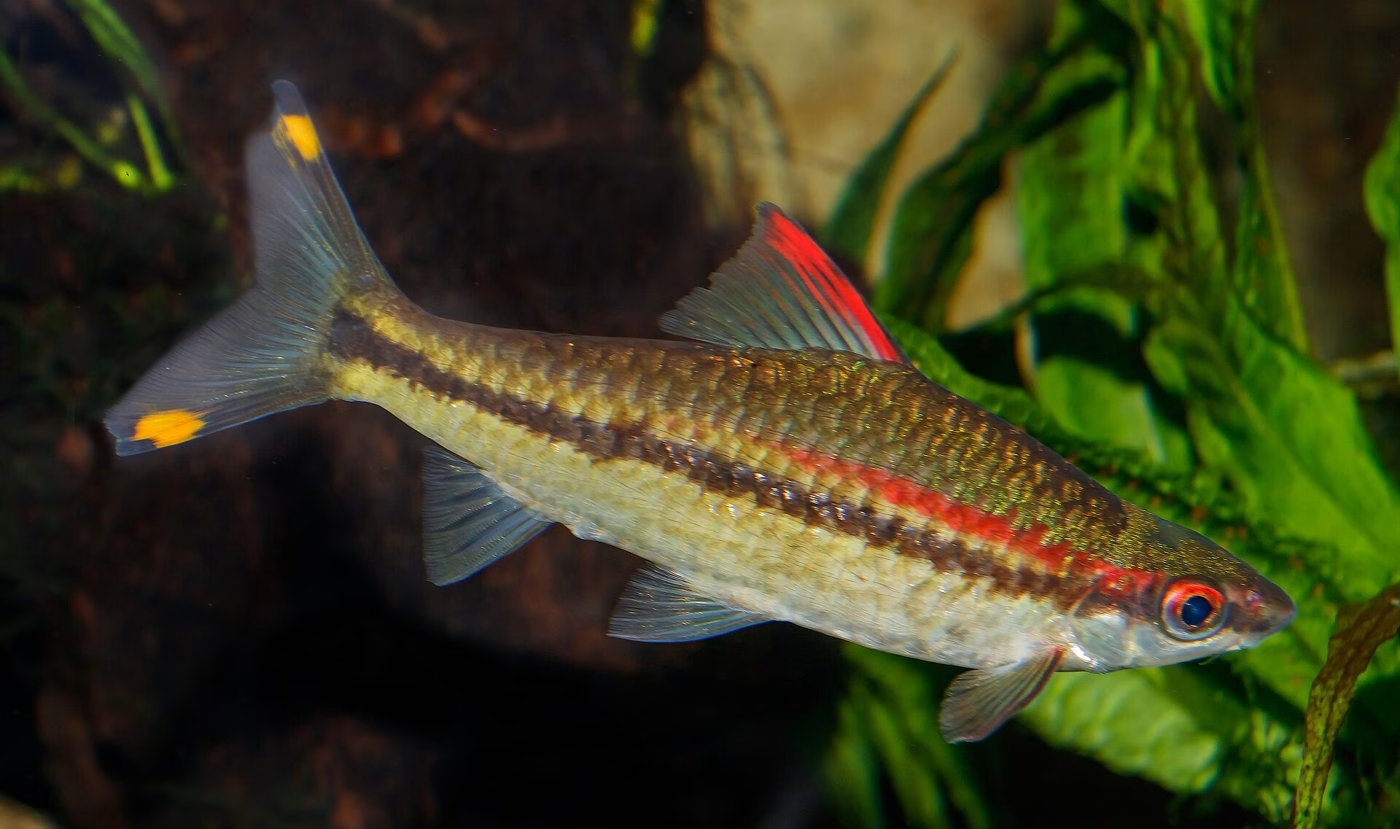
The Denison barb, also sold as the red-line torpedo barb or roseline shark, is a sleek, silver torpedo with a black line, a bright red stripe and yellow-and-black tail tips. A big shoal in a long, flowing tank is one of the best freshwater sights going.
| Scientific name | Sahyadria denisonii |
|---|---|
| Family | Cyprinidae |
| Origin | Western Ghats rivers, Kerala and Karnataka, India |
| Adult size | 15 cm |
| Lifespan | 5 to 8 years |
| Minimum tank | 300 litres (150 cm long) |
| Temperature | 15 to 25°C |
| pH | 6.8 to 7.8 |
| Hardness | Up to 25 dGH |
| Swims in | Middle |
| Temperament | Peaceful, active |
| Group size | 6 or more |
| Diet | Omnivore: pellets, flake, frozen foods, vegetable matter |
| Difficulty | Moderate |
What it is like to keep
Denisons are fast, active river fish that need swimming room, high oxygen and a group. Kept singly or in pairs they become nervous and lose colour. They also grow bigger than most people expect, so a long tank is essential.
Wild populations were heavily over-collected for the aquarium trade and the species is listed as endangered. Most fish in UK shops are now farmed; choose captive-bred stock.
Setting up the tank
At least 150 cm long and 300 litres, with strong flow from a powerhead or spraybar, smooth rocks, some wood and hardy plants such as Anubias and Java fern around the edges. Keep the middle open. A tight lid stops them jumping. They prefer it slightly cooler than many tropicals, around 22 to 24°C.
Feeding
Quality pellets and flake with frozen bloodworm, brine shrimp and mysis, plus some vegetable matter such as spirulina flake.
Breeding
Rarely bred in home aquaria; commercial farms use hormone-induced spawning.
Tank mates
Good with other active, robust fish: danios, rosy barbs, clown loaches, hillstream loaches (in cooler set-ups), rainbowfish and bristlenose plecos. Too boisterous for timid nano fish.
Graham’s tip: Give them a river, not a pond. A long tank with a strong current and a shoal of eight and you’ll see colour that shop tanks never show.
More care sheets: Species Profiles. Questions? Ask in the comments below and I’ll answer.
Photo: H. Zell, CC BY-SA 3.0, via Wikimedia Commons.


Get in touch I’d love to hear from you