
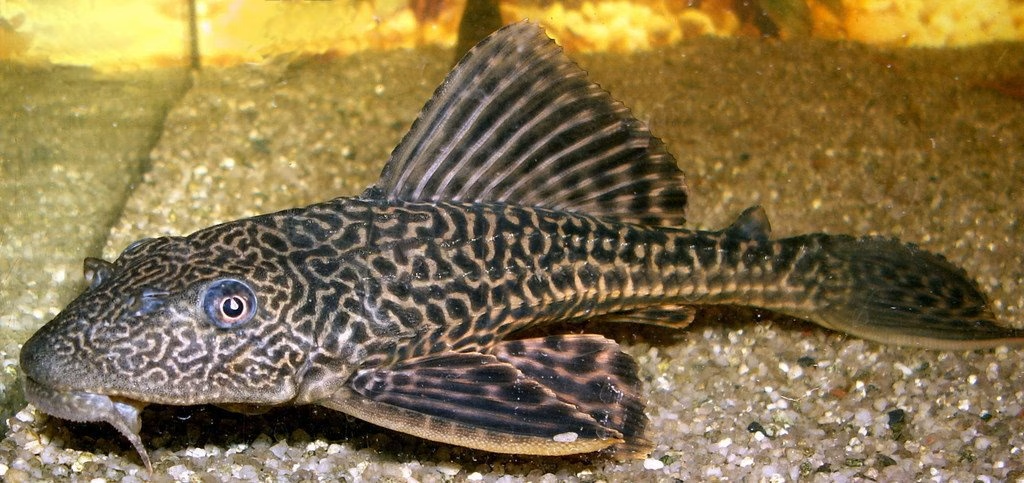
The common pleco, or sailfin pleco, is the fish sold as a cheap “algae eater” in almost every shop. It’s hardy and fascinating, but it grows into a 40 cm, waste-producing giant that needs a huge tank.
| Scientific name | Pterygoplichthys pardalis and related species |
|---|---|
| Family | Loricariidae |
| Origin | Amazon basin, South America |
| Adult size | 35 to 45 cm |
| Lifespan | 15 to 20 years |
| Minimum tank | 500 litres plus |
| Temperature | 22 to 28°C |
| pH | 6.5 to 7.8 |
| Hardness | Up to 25 dGH |
| Swims in | Bottom |
| Temperament | Peaceful but very large |
| Group size | Singly |
| Diet | Omnivore: vegetables, algae wafers, sinking pellets, driftwood |
| Difficulty | Easy to keep, hard to house |
What it is like to keep
This is the pleco I most often see in tanks that are far too small. A 5 cm baby will reach 30 cm within a few years. It also produces a lot of waste and becomes less interested in algae as it grows. If you have a 500 litre tank or a pond-sized set-up, it’s a great fish; otherwise, choose a bristlenose or clown pleco.
Setting up the tank
At least 500 litres with powerful filtration, large caves and driftwood. Sturdy décor, because it will move things.
Feeding
Algae wafers, sinking pellets, vegetables such as courgette, cucumber and sweet potato, and driftwood.
Breeding
Not bred in home aquaria; spawns in burrows in riverbanks in the wild.
Tank mates
Large, robust fish: oscars, severums, silver dollars and bala sharks in very large tanks.
Graham’s tip: Never release a pleco. They’ve become invasive in rivers around the world. If yours outgrows its tank, contact your local fish club or shop for rehoming.
More care sheets: Species Profiles. Questions? Ask in the comments below and I’ll answer.
Photo: Staszek_Szybki_Jest, CC BY-SA, via iNaturalist.
Get in touch I’d love to hear from you