
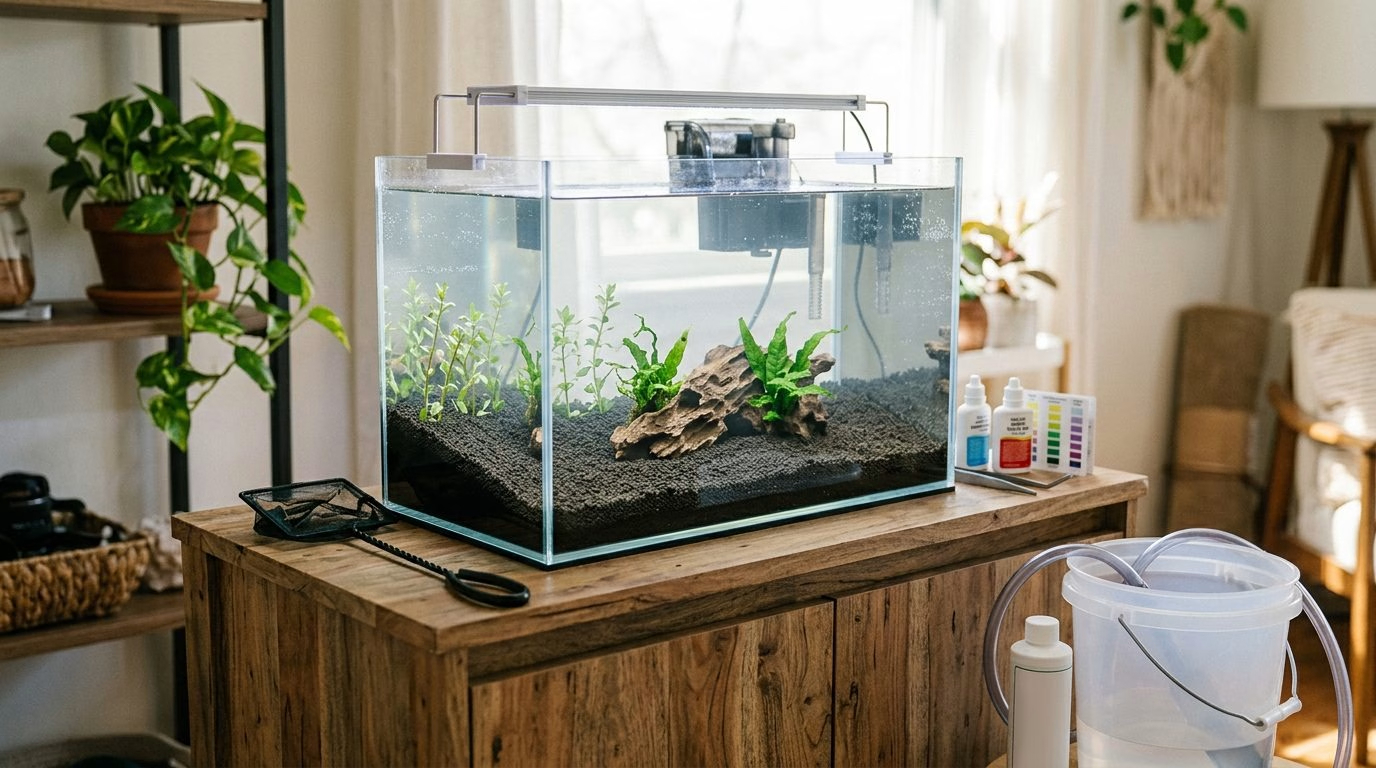
Most first tanks fail for the same three reasons: fish added too soon, too many fish, and the wrong fish. Follow this page in order and you’ll dodge all three.
1. Pick the right tank
Bigger is easier. A 60 to 120 litre tank is far more forgiving than a 20 litre nano, because mistakes get diluted. Make sure the floor and stand can take the weight: water is 1 kg per litre, before glass and gravel.
Read: Your first aquarium: equipment needed on a budget.
2. Set it up properly
Choose planted or not. Live plants help hugely with water quality, and easy ones like java fern, anubias and Amazon swords need no special kit.
3. Cycle the tank before any fish go in
This is the step everyone wants to skip. A new filter has no bacteria to process fish waste, so ammonia builds up and poisons the fish. That’s “new tank syndrome”. Cycling grows those bacteria first.
- Fill the tank, dechlorinate, and run the filter and heater.
- Add an ammonia source (pure ammonia dosed to about 2 ppm, or a pinch of fish food every day).
- Test every few days with a liquid test kit. You’ll see ammonia rise, then nitrite, then both fall to zero as nitrate appears.
- When ammonia and nitrite read zero within 24 hours of dosing, you’re cycled. It usually takes four to six weeks.
- Do a big water change to bring nitrate down, then add your first few fish.
Graham’s rule: if you haven’t tested it, you don’t know it. Strips are better than nothing; a liquid test kit is better than strips.
4. Choose fish that suit the tank
Stock slowly, a few fish every couple of weeks, and research adult size, not shop size. Start with hardy shoaling fish rather than a mix of singletons.
- How many fish can I keep in my tank?
- Tank busters: the fish shops sell small that grow huge
- Species A to Z
5. Keep a simple routine
| How often | Job |
|---|---|
| Daily | Feed a little, count the fish, check the thermometer |
| Weekly | Change 20 to 30% of the water with dechlorinated, temperature-matched water; wipe the glass |
| Monthly | Rinse filter sponges in old tank water (never tap water); test ammonia, nitrite, nitrate and pH |
| Yearly | Replace heater if over five years old, check seals and hoses |
Read: How to clean your filter and Help, my tank is constantly mucky.
6. When something goes wrong
Don’t panic and don’t pour in three medicines at once. Test the water first, then head to the Fish Health Clinic.