
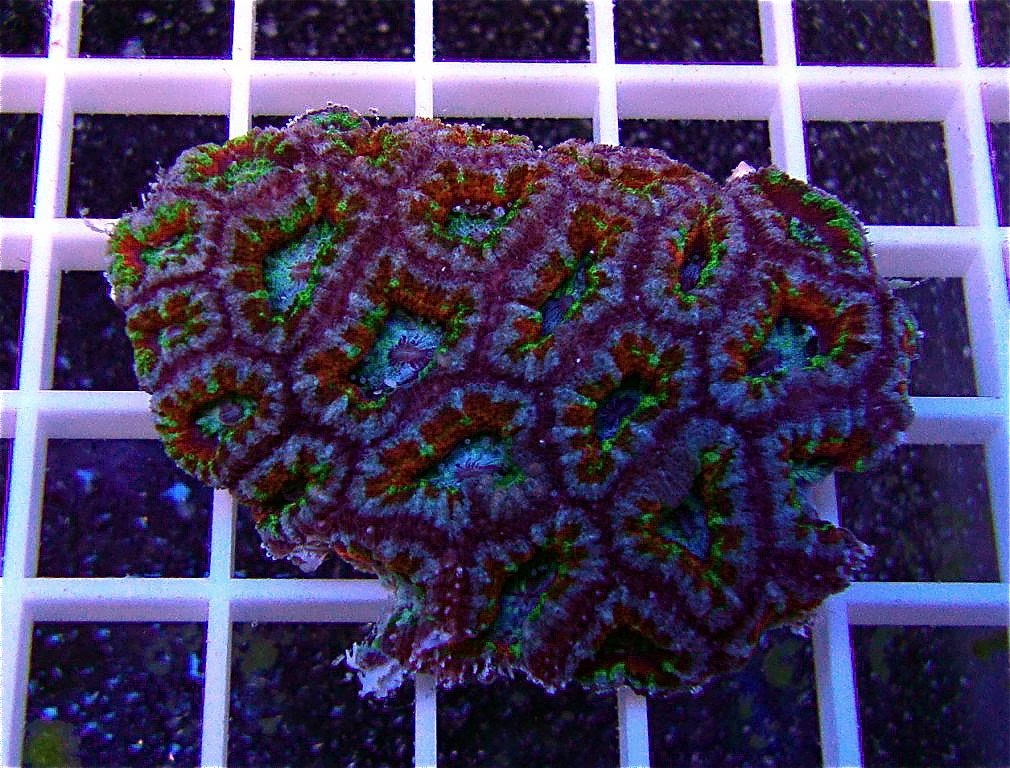
Acans are colourful, fleshy encrusting corals with large polyps. Prized for their colours. This Acan Coral care sheet covers everything you need to keep one well.
| Scientific name | Micromussa lordhowensis (formerly Acanthastrea) |
|---|---|
| Type | LPS |
| Origin | Australia |
| Lighting | Low to moderate |
| Water flow | Low to moderate |
| Placement | Lower rock |
| Growth | Slow to moderate |
| Aggression | Short sweepers |
| Feeding | Photosynthetic; feeds well |
| Water | 24 to 26°C, 1.025 to 1.026 SG, alkalinity 7 to 9 dKH, calcium 400 to 450 ppm, magnesium 1,300 to 1,400 ppm |
| Difficulty | Easy |
What it is like to keep
Acans form fleshy, encrusting colonies of large polyps in vivid colours. Captive-grown morphs are prized.
They are peaceful, with short sweepers. They respond well to feeding.
Captive-grown acans come in some of the wildest colour combinations in the hobby, from rainbow to “bowerbanki” types. They grow by adding polyps around the edge of the colony. Feeding is the single biggest factor in growth: an acan fed twice a week will outpace one left on light alone.
Placement, light and flow
Lower rock with low to moderate light and low to moderate flow.
Feeding
Target-feed small meaty foods at night when feeding tentacles extend.
Propagation and fragging
Cut along polyp lines with a wet saw or bone cutters.
Neighbours and compatibility
Peaceful, but keep away from aggressive Euphyllia and fast-growing soft corals.
Graham’s tip: Feed acans at night when their feeding tentacles come out.
More care sheets: LPS Corals. Questions? Ask in the comments below and I’ll answer.
Get in touch I’d love to hear from you