
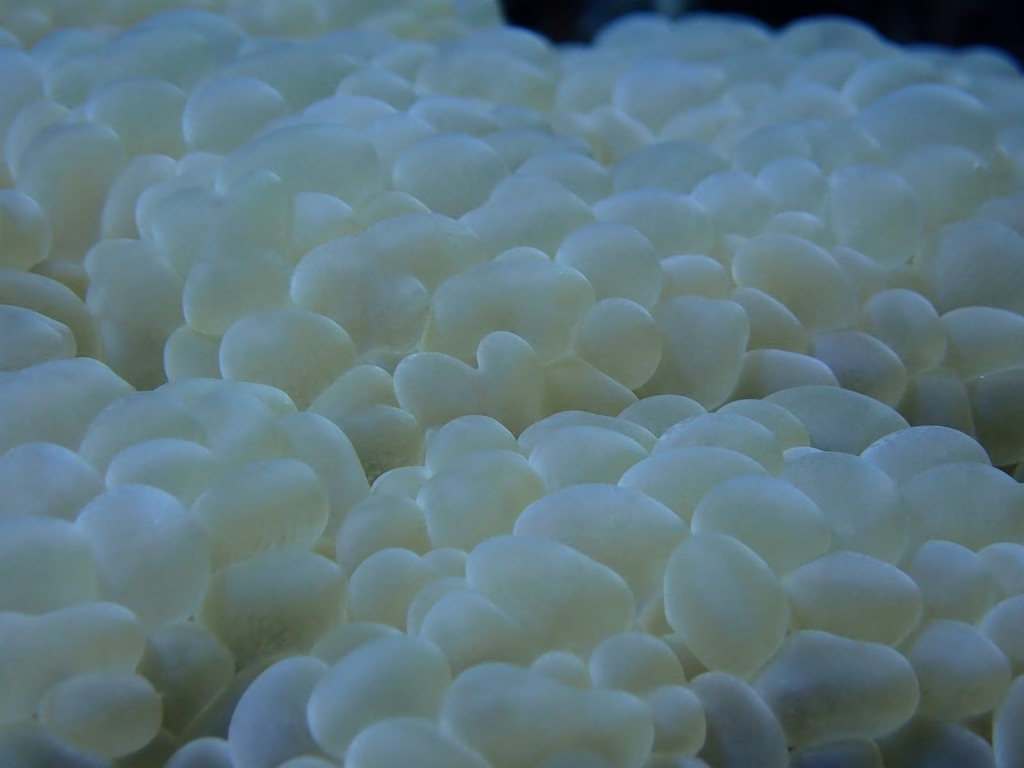
The bubble coral has grape-like bubbles during the day that retract at night to release sweepers.
| Scientific name | Plerogyra sinuosa |
|---|---|
| Type | LPS |
| Origin | Indo-Pacific and Red Sea |
| Lighting | Low to moderate |
| Water flow | Low |
| Placement | Lower rock with space |
| Growth | Slow |
| Aggression | Strong sweepers at night |
| Feeding | Photosynthetic; meaty foods |
| Water | 24 to 26°C, 1.025 to 1.026 SG, alkalinity 7 to 9 dKH, calcium 400 to 450 ppm, magnesium 1,300 to 1,400 ppm |
| Difficulty | Moderate |
What it is like to keep
Bubble coral expands grape-like vesicles during the day and retracts them at night to extend sweeper tentacles. The bubbles are delicate and tear easily.
It’s a moderately easy LPS with strong sweepers, so give it room.
Plerogyra are usually cream, green or pearly white. The bubbles are filled with water and swell during the day to give the zooxanthellae more surface for light. A bubble coral that stays deflated may be getting too much flow or light, or being picked at by fish or crabs.
Placement, light and flow
Lower rock with low to moderate light and low flow. Keep it away from hermit crabs and pumps.
Feeding
Target-feed small meaty foods at night once a week.
Propagation and fragging
Rarely fragged. Colonies sometimes produce new heads.
Neighbours and compatibility
Keep space from other corals. Peaceful with fish.
Graham’s tip: Bubbles can be torn by hermit crabs. Keep them away.
More care sheets: LPS Corals. Questions? Ask in the comments below and I’ll answer.
Photo: Juraj Ahel, CC BY, via iNaturalist.
Get in touch I’d love to hear from you