
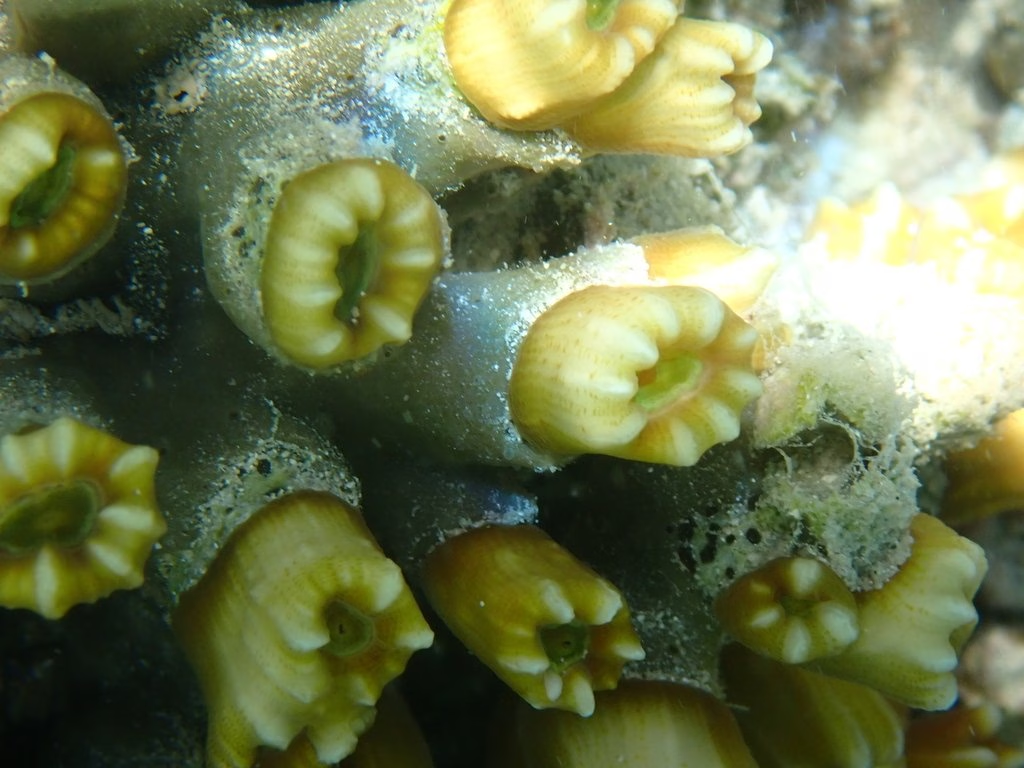
Candy cane coral, or trumpet coral, has striped heads on short branches. Hardy and peaceful.
| Scientific name | Caulastraea furcata |
|---|---|
| Type | LPS |
| Origin | Indo-Pacific |
| Lighting | Moderate |
| Water flow | Low to moderate |
| Placement | Lower to middle rock |
| Growth | Moderate |
| Aggression | Low |
| Feeding | Photosynthetic; accepts meaty foods |
| Water | 24 to 26°C, 1.025 to 1.026 SG, alkalinity 7 to 9 dKH, calcium 400 to 450 ppm, magnesium 1,300 to 1,400 ppm |
| Difficulty | Easy |
What it is like to keep
Candy cane coral, or trumpet coral, grows as a branching colony of round heads with striped tissue. It’s one of the easiest LPS and grows steadily.
It has short sweepers but is generally peaceful.
Each head is a separate polyp with a green, brown or neon centre and a striped “candy cane” ring. The colony branches as it grows, so a single-head frag can become a 20-head colony in a year or two. At night it extends small feeding tentacles that capture food, which is the best time to feed.
Placement, light and flow
Lower to middle rock with moderate light and low to moderate flow.
Feeding
Photosynthetic, but target-feeding small meaty foods at night speeds growth.
Propagation and fragging
Snip off a head with bone cutters and glue to a plug.
Neighbours and compatibility
Peaceful with most corals. Keep away from aggressive Euphyllia.
Graham’s tip: A good “filler” coral that’s cheap, easy and grows well.
More care sheets: LPS Corals. Questions? Ask in the comments below and I’ll answer.
Photo: Debra Baker, CC BY, via iNaturalist.
Get in touch I’d love to hear from you