
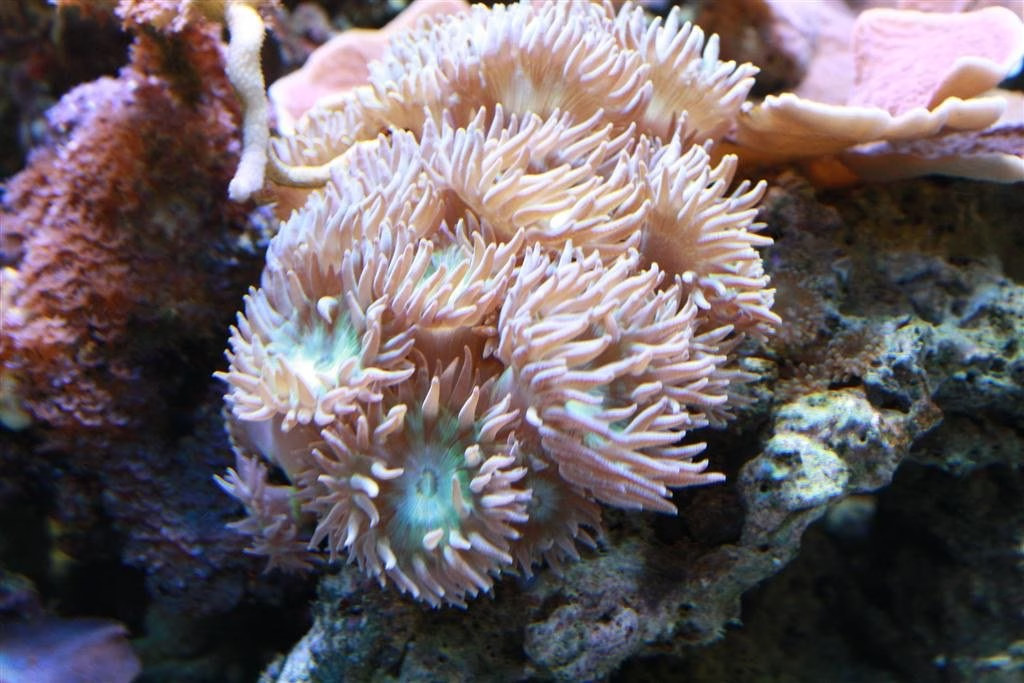
Duncan corals have green-centred polyps with long tentacles on branching stems. Easy and fast to bud.
| Scientific name | Duncanopsammia axifuga |
|---|---|
| Type | LPS |
| Origin | Australia |
| Lighting | Low to moderate |
| Water flow | Low to moderate |
| Placement | Lower rock or sand |
| Growth | Moderate, buds new heads |
| Aggression | Low |
| Feeding | Photosynthetic; feeds eagerly |
| Water | 24 to 26°C, 1.025 to 1.026 SG, alkalinity 7 to 9 dKH, calcium 400 to 450 ppm, magnesium 1,300 to 1,400 ppm |
| Difficulty | Easy |
What it is like to keep
Duncans are one of the easiest LPS and grow by budding new heads. Each head has a green or purple centre ringed with long tentacles.
They are peaceful and rarely sting neighbours. They respond very well to feeding.
They are a great first LPS because they show clearly how well they’re doing: a fed, happy Duncan colony adds new heads every few weeks, and the tentacles stay extended through the day. Shrunken heads usually mean too much flow or a fish nipping at them.
Placement, light and flow
Lower rock or sand bed with low to moderate light and low to moderate flow.
Feeding
Target-feed mysis, small pellets or chopped shrimp once or twice a week. They grow much faster when fed.
Propagation and fragging
Snip off a head with bone cutters and glue to a frag plug.
Neighbours and compatibility
Peaceful with most corals and fish.
Graham’s tip: Feed Duncans and they’ll pay you back with new heads every month.
More care sheets: LPS Corals. Questions? Ask in the comments below and I’ll answer.
Get in touch I’d love to hear from you