
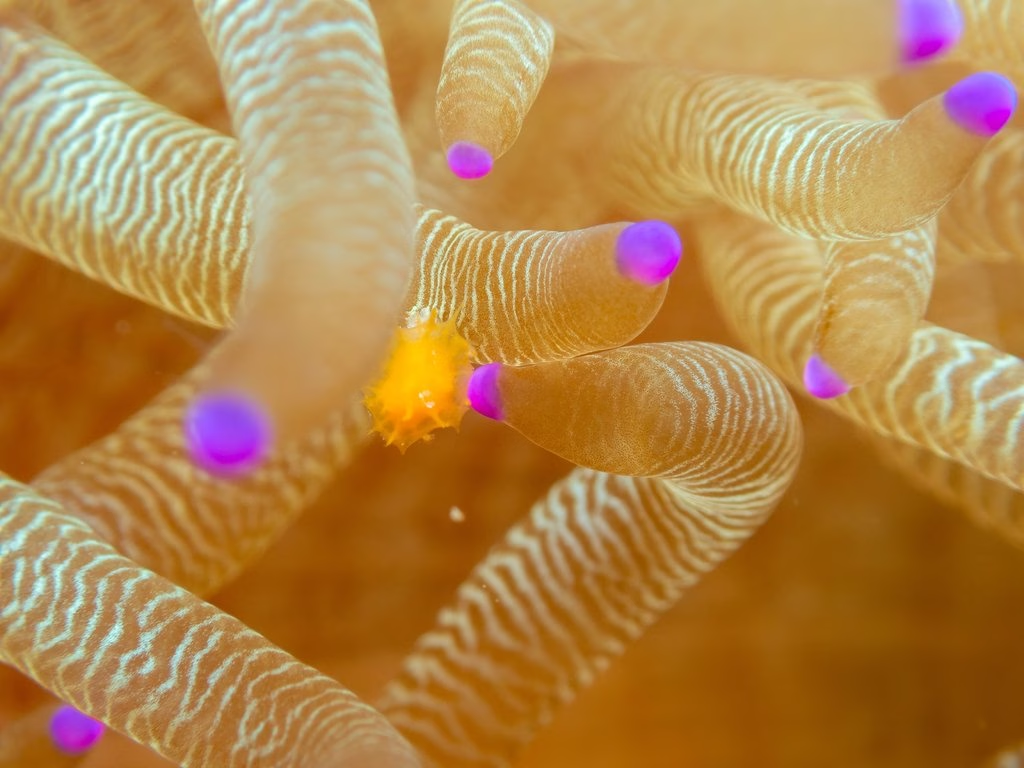
The elegance coral has long, flowing tentacles with pink tips. A showpiece LPS.
| Scientific name | Catalaphyllia jardinei |
|---|---|
| Type | LPS |
| Origin | Indo-Pacific |
| Lighting | Moderate |
| Water flow | Low to moderate |
| Placement | On the sand bed |
| Growth | Slow |
| Aggression | Strong sting |
| Feeding | Photosynthetic; meaty foods |
| Water | 24 to 26°C, 1.025 to 1.026 SG, alkalinity 7 to 9 dKH, calcium 400 to 450 ppm, magnesium 1,300 to 1,400 ppm |
| Difficulty | Moderate |
What it is like to keep
The elegance coral (Catalaphyllia) has long, flowing tentacles, usually green with pink or purple tips, over a fleshy oral disc. It looks like an anemone and is one of the most striking LPS.
It had a bad reputation in the 2000s, when many wild-collected colonies wasted away with “elegance coral syndrome”. Today’s aquacultured colonies are much hardier. It has a strong sting and long sweepers, and it can expand to twice its daytime size at night.
Placement, light and flow
Place it on the sand bed, not on rock: in the wild it lives on soft, silty bottoms. Moderate light and gentle flow. Give it at least 15 cm of space.
Feeding
Photosynthetic, but it benefits from meaty foods (mysis, chopped shrimp) once a week.
Propagation and fragging
Rarely fragged; best left to grow.
Neighbours and compatibility
Keep well away from other corals. Clownfish sometimes host in it.
Graham’s tip: Buy aquacultured elegance corals. Wild ones are much less reliable.
More care sheets: LPS Corals. Questions? Ask in the comments below and I’ll answer.
Photo: Pierre Pericard, CC BY, via iNaturalist.
Get in touch I’d love to hear from you