
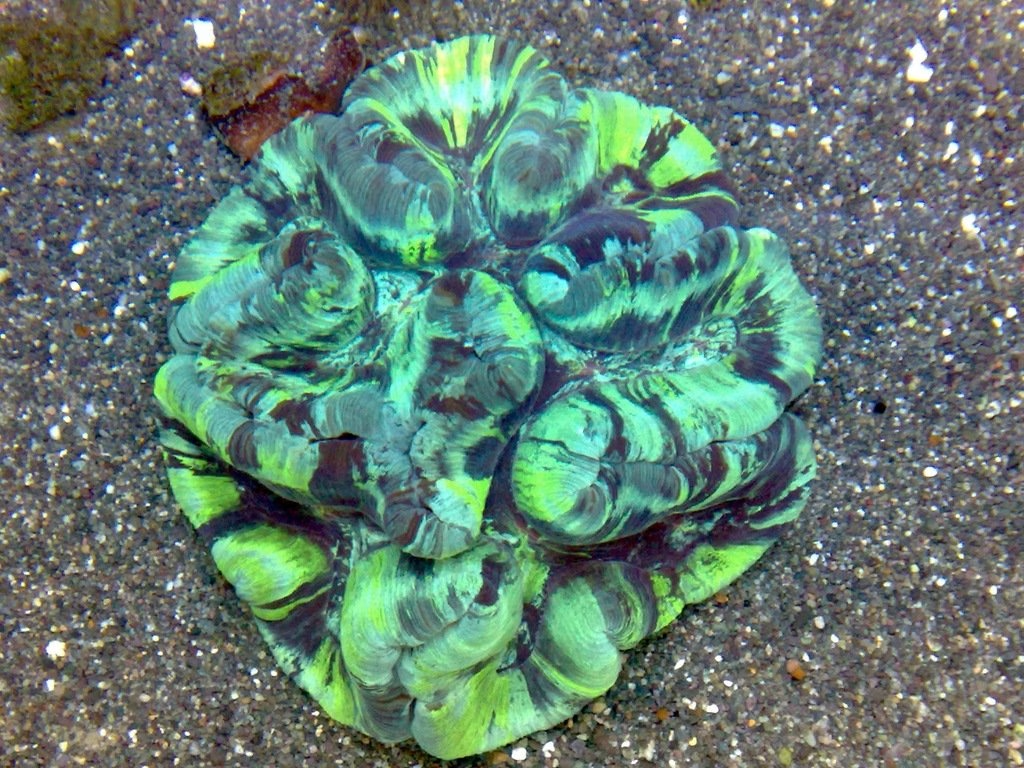
The open brain coral is a free-living LPS that sits on the sand. Fleshy and colourful.
| Scientific name | Trachyphyllia geoffroyi |
|---|---|
| Type | LPS |
| Origin | Indo-Pacific |
| Lighting | Low to moderate |
| Water flow | Low |
| Placement | On the sand bed |
| Growth | Slow |
| Aggression | Low |
| Feeding | Photosynthetic; meaty foods |
| Water | 24 to 26°C, 1.025 to 1.026 SG, alkalinity 7 to 9 dKH, calcium 400 to 450 ppm, magnesium 1,300 to 1,400 ppm |
| Difficulty | Easy |
What it is like to keep
The open brain coral (Trachyphyllia) is a free-living LPS that sits loose on the sand rather than attaching to rock. Its fleshy, folded tissue comes in green, red, pink and multi-coloured forms, and it inflates noticeably at night.
It is fairly easy and peaceful. The main mistake is placing it on rock, where it can tear its tissue or fall; it belongs on the sand bed.
Placement, light and flow
On the sand bed in low to moderate light and gentle flow. Strong flow stops it inflating fully.
Feeding
Target-feed meaty foods such as mysis or chopped shrimp once a week, placed on the mouth. It will close around food and digest it over a few hours.
Propagation and fragging
Not easily fragged; occasionally produces new mouths as it grows.
Neighbours and compatibility
Peaceful. Keep away from nippy fish such as dwarf angels and butterflyfish, and from hermit crabs that might climb on it.
Graham’s tip: Keep it on the sand. Placed on rock it can tear its tissue.
More care sheets: LPS Corals. Questions? Ask in the comments below and I’ll answer.
Photo: bondolo, CC BY, via iNaturalist.
Get in touch I’d love to hear from you