
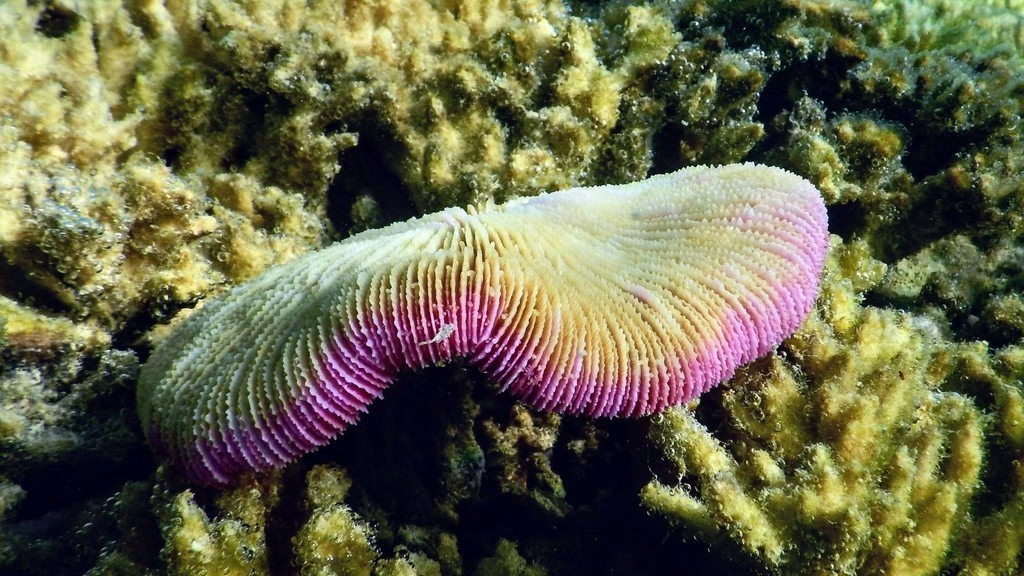
Plate corals are free-living, disc-shaped LPS that sit on the sand. They can move slowly.
| Scientific name | Fungia spp. |
|---|---|
| Type | LPS (free-living) |
| Origin | Indo-Pacific |
| Lighting | Moderate |
| Water flow | Low to moderate |
| Placement | On the sand bed |
| Growth | Slow |
| Aggression | Low |
| Feeding | Photosynthetic; meaty foods |
| Water | 24 to 26°C, 1.025 to 1.026 SG, alkalinity 7 to 9 dKH, calcium 400 to 450 ppm, magnesium 1,300 to 1,400 ppm |
| Difficulty | Easy |
What it is like to keep
Plate corals (Fungia and relatives) are free-living, disc-shaped LPS that lie loose on the sand. Each “plate” is a single giant polyp, and many species can slowly crawl across the sand and even turn themselves back over if flipped.
They are peaceful and fairly easy, with long tentacles extended during the day in most species. Colours range from brown and green to vivid pink and purple.
Placement, light and flow
On the sand bed with moderate light and gentle flow. Never glue them to rock.
Feeding
Photosynthetic, but they catch food readily. Target-feed small meaty foods once a week.
Propagation and fragging
Some plates produce small “anthocauli” buds on the skeleton that can be removed and grown on.
Neighbours and compatibility
Peaceful. Keep a few centimetres from other corals. Hermit crabs and urchins can damage the tissue if they wander over it.
Graham’s tip: Don’t glue plates to rock. They belong on the sand.
More care sheets: LPS Corals. Questions? Ask in the comments below and I’ll answer.
Photo: Attila Oláh, CC BY, via iNaturalist.
Get in touch I’d love to hear from you