
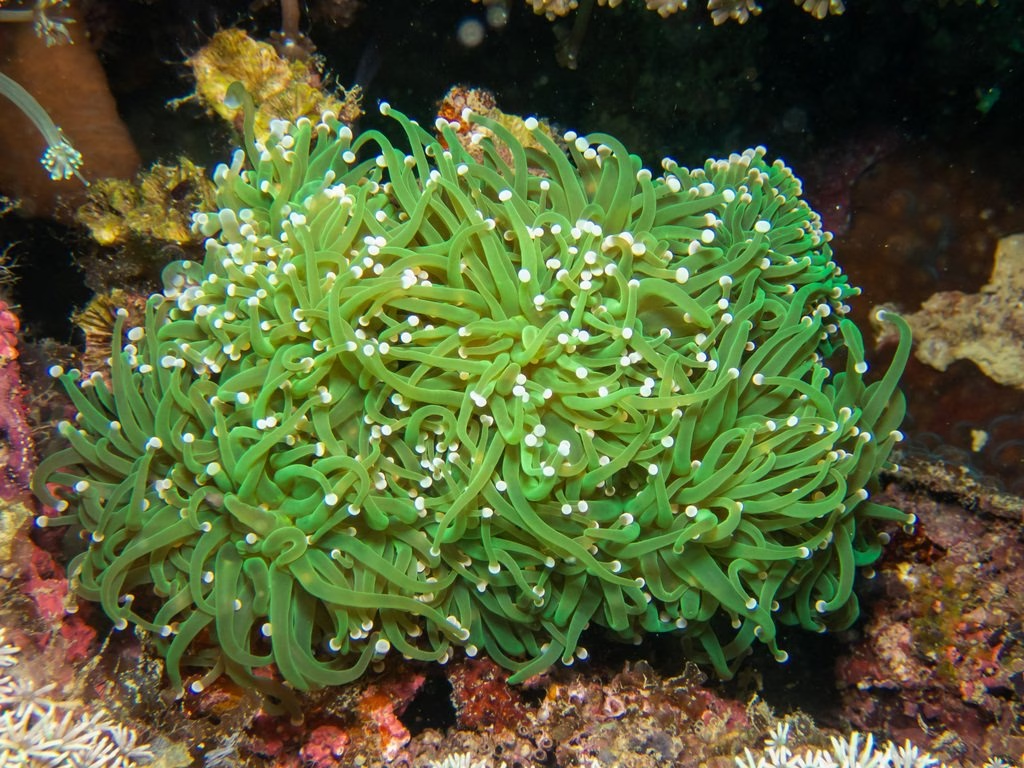
The torch coral has long, flowing tentacles with coloured tips. A beautiful but aggressive LPS.
| Scientific name | Euphyllia glabrescens |
|---|---|
| Type | LPS |
| Origin | Indo-Pacific |
| Lighting | Moderate |
| Water flow | Moderate |
| Placement | Middle, with space |
| Growth | Moderate |
| Aggression | Strong sting |
| Feeding | Photosynthetic; meaty foods |
| Water | 24 to 26°C, 1.025 to 1.026 SG, alkalinity 7 to 9 dKH, calcium 400 to 450 ppm, magnesium 1,300 to 1,400 ppm |
| Difficulty | Moderate |
What it is like to keep
Torch corals have long, flowing tentacles with coloured tips that move constantly in the current. Gold, green and the famous “Indo gold” and “dragon soul” morphs are prized.
They have one of the strongest stings of the Euphyllia and extend long sweepers at night. Give them 15 to 20 cm clearance. Clownfish often host in torches if there’s no anemone, which some colonies tolerate and others don’t.
Torches suffered from a disease outbreak (Euphyllia tissue loss) in recent years; buy from a trusted source and quarantine new colonies.
Placement, light and flow
Middle rock with moderate light and moderate, indirect flow. Avoid strong direct flow, which tears the tissue.
Feeding
Mainly photosynthetic. Target-feed small meaty foods once a week.
Propagation and fragging
Branching torches split at the heads; cut between them with a bone cutter.
Neighbours and compatibility
Keep well away from other corals. Fine with fish; watch clownfish don’t harass it.
Graham’s tip: Torches are often the coral a clownfish hosts in without an anemone. Watch the clowns don’t smother it.
More care sheets: LPS Corals. Questions? Ask in the comments below and I’ll answer.
Photo: portioid, CC BY, via iNaturalist.
Get in touch I’d love to hear from you