
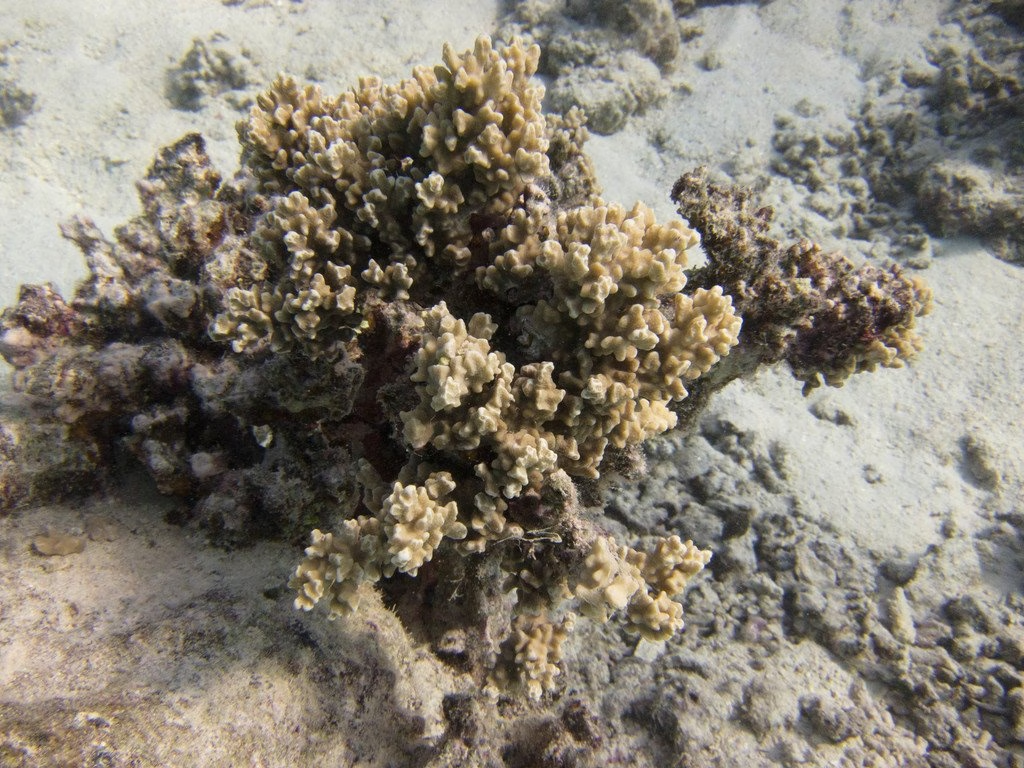
Porites are dense, finger or boulder-shaped SPS. Hardy and slow growing.
| Scientific name | Porites spp. |
|---|---|
| Type | SPS |
| Origin | Indo-Pacific and Caribbean |
| Lighting | Moderate to high |
| Water flow | Moderate |
| Placement | Middle rock |
| Growth | Slow to moderate |
| Aggression | Low |
| Feeding | Photosynthetic |
| Water | 24 to 26°C, 1.025 to 1.026 SG, alkalinity 7 to 9 dKH, calcium 400 to 450 ppm, magnesium 1,300 to 1,400 ppm |
| Difficulty | Moderate |
What it is like to keep
Porites are dense, slow-growing SPS that form fingers (Porites cylindrica), boulders (P. lobata) or plates, usually in cream, yellow, purple or blue. They are some of the toughest stony corals you can keep, tolerating moderate nutrients and small swings in chemistry better than most SPS.
Many boulder Porites come with Christmas tree worms living in them, which put on a colourful show of their own; keep the colony away from fish that nip worms. Growth is slow, so a frag stays manageable for years.
Placement, light and flow
Middle rock with moderate to high light and moderate flow.
Feeding
Photosynthetic.
Propagation and fragging
Cut or snap pieces with a saw or bone cutters.
Neighbours and compatibility
Peaceful with fish. Keep space from aggressive corals.
Graham’s tip: Porites are great for a natural-looking reef. Many come with Christmas tree worms living in them.
More care sheets: SPS Corals. Questions? Ask in the comments below and I’ll answer.
Photo: Ryan McMinds, CC BY, via iNaturalist.
Get in touch I’d love to hear from you