
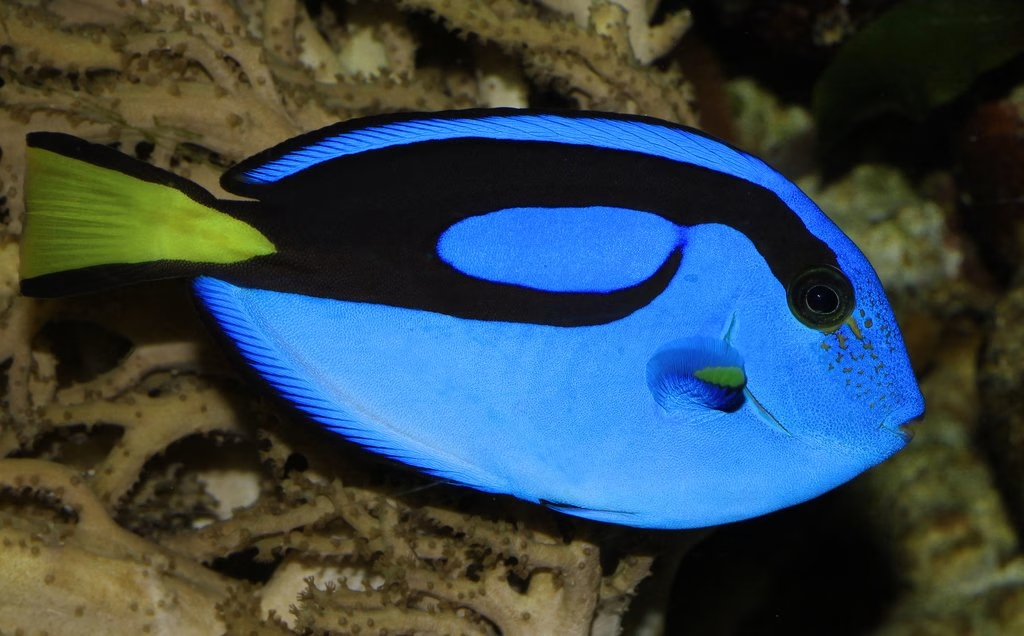
The blue tang is the fish everyone wants after watching animated films. It grows to 30 cm, needs a very long tank and is prone to whitespot.
| Scientific name | Paracanthurus hepatus |
|---|---|
| Family | Acanthuridae |
| Origin | Indo-Pacific |
| Adult size | 25 to 30 cm |
| Lifespan | 10 to 20 years |
| Minimum tank | 600 litres plus (180 cm long) |
| Temperature | 24 to 27°C |
| pH | 8.1 to 8.4 |
| Salinity | 1.023 to 1.026 SG |
| Swims in | Middle |
| Temperament | Peaceful to other species, aggressive to tangs |
| Group size | Singly |
| Reef safe | Yes |
| Diet | Omnivore: algae, nori, frozen foods |
| Difficulty | Moderate |
What it is like to keep
Blue tangs are skittish, prone to marine whitespot (Cryptocaryon) and need lots of swimming room. Captive-bred specimens are now available and are better choices.
Setting up the tank
At least 180 cm long, 600 litres plus, with plenty of rock caves.
Feeding
Nori and algae daily, plus frozen mysis and marine pellets.
Breeding
Recently captive-bred commercially; not at home.
Tank mates
Peaceful reef fish in large tanks: clowns, grammas, other tangs only in huge tanks.
Graham’s tip: Quarantine every tang. It’s the single best way to keep whitespot out of a reef tank.
More care sheets: Marine Fish Database. Questions? Ask in the comments below and I’ll answer.
Photo: H. Krisp, CC BY, via iNaturalist.
Get in touch I’d love to hear from you