
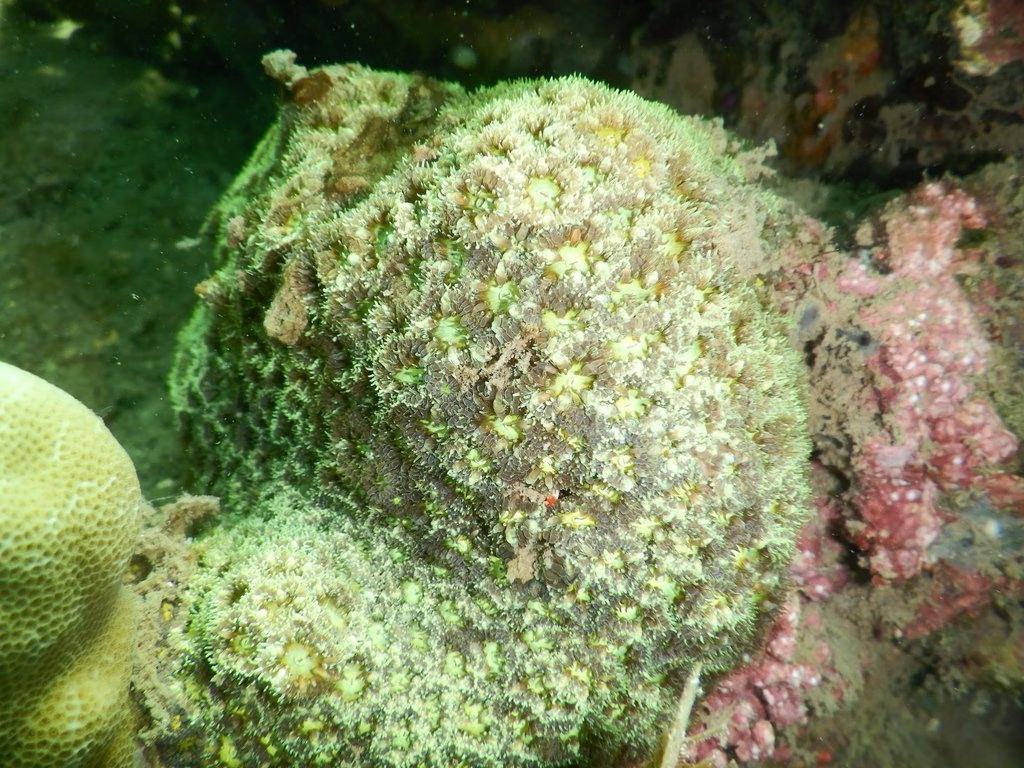
Blastomussa have fleshy, colourful polyps. Easy and peaceful.
| Scientific name | Blastomussa wellsi and B. merleti |
|---|---|
| Type | LPS |
| Origin | Indo-Pacific |
| Lighting | Low to moderate |
| Water flow | Low to moderate |
| Placement | Lower rock |
| Growth | Slow to moderate |
| Aggression | Low |
| Feeding | Photosynthetic; meaty foods |
| Water | 24 to 26°C, 1.025 to 1.026 SG, alkalinity 7 to 9 dKH, calcium 400 to 450 ppm, magnesium 1,300 to 1,400 ppm |
| Difficulty | Easy |
What it is like to keep
Blastomussa have large, fleshy polyps in red, green and pink, packed tightly together. Blastomussa wellsi forms dense mats of polyps; B. merleti has smaller polyps on longer stalks.
They are among the easiest LPS, tolerating low light and modest flow, and they grow steadily. They are a good choice for the shaded lower parts of a reef.
Blastos rarely sting neighbours, so they work well in mixed coral gardens. If the polyps look shrunken and you can see skeleton, it usually means too much light or flow, not too little.
Placement, light and flow
Lower rock or rubble with low to moderate light and gentle flow.
Feeding
Photosynthetic, but they love meaty foods. Target-feed small mysis or pellets once a week.
Propagation and fragging
Cut between polyps with bone cutters and glue to plugs; very forgiving.
Neighbours and compatibility
Peaceful, but keep away from aggressive Euphyllia and brain corals with long sweepers.
Graham’s tip: Blastos are perfect for low-light areas.
More care sheets: LPS Corals. Questions? Ask in the comments below and I’ll answer.
Photo: Ewout Knoester, CC BY-SA, via iNaturalist.
Get in touch I’d love to hear from you