
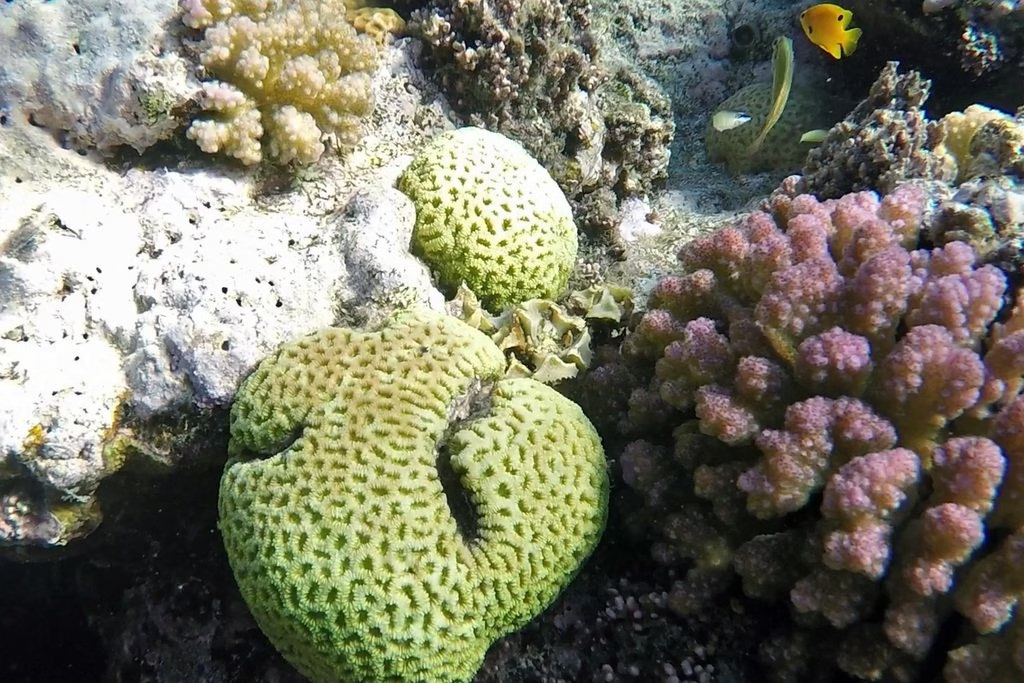
Favia brain corals are colourful, cratered LPS that form domes. Hardy and attractive.
| Scientific name | Dipsastraea spp. (formerly Favia) |
|---|---|
| Type | LPS |
| Origin | Indo-Pacific |
| Lighting | Moderate |
| Water flow | Moderate |
| Placement | Lower to middle |
| Growth | Slow |
| Aggression | Long sweepers |
| Feeding | Photosynthetic; meaty foods |
| Water | 24 to 26°C, 1.025 to 1.026 SG, alkalinity 7 to 9 dKH, calcium 400 to 450 ppm, magnesium 1,300 to 1,400 ppm |
| Difficulty | Easy |
What it is like to keep
Favia (now Dipsastraea) brain corals form domed colonies of round, cratered polyps, often in contrasting colours such as green with red or purple centres. They are hardy, slow-growing LPS that cope well with normal reef conditions.
Don’t be fooled by how compact they look in daylight. At night they push out long, clear sweeper tentacles that can reach 10 cm or more and sting neighbouring corals. Turn the pumps off with a torch one evening and you’ll see exactly how much room it needs.
Placement, light and flow
Lower to middle rock with moderate light (100 to 200 PAR) and moderate, indirect flow. Place it where sweepers can’t reach other corals.
Feeding
Photosynthetic, but it captures food readily. Target-feed mysis, small pellets or chopped shrimp at night, when the feeding tentacles are out, once or twice a week.
Propagation and fragging
Cut along the gaps between polyps with a wet band saw or a sturdy bone cutter, then glue each piece to a plug. Slow to recover, so only frag healthy colonies.
Neighbours and compatibility
Peaceful with fish. Keep at least 10 cm from other corals, especially acans, Blastomussa and Zoanthids.
Graham’s tip: Don’t be fooled by how small they look by day. Night sweepers reach far.
More care sheets: LPS Corals. Questions? Ask in the comments below and I’ll answer.
Photo: Tom Heijnen, CC BY, via iNaturalist.
Get in touch I’d love to hear from you