
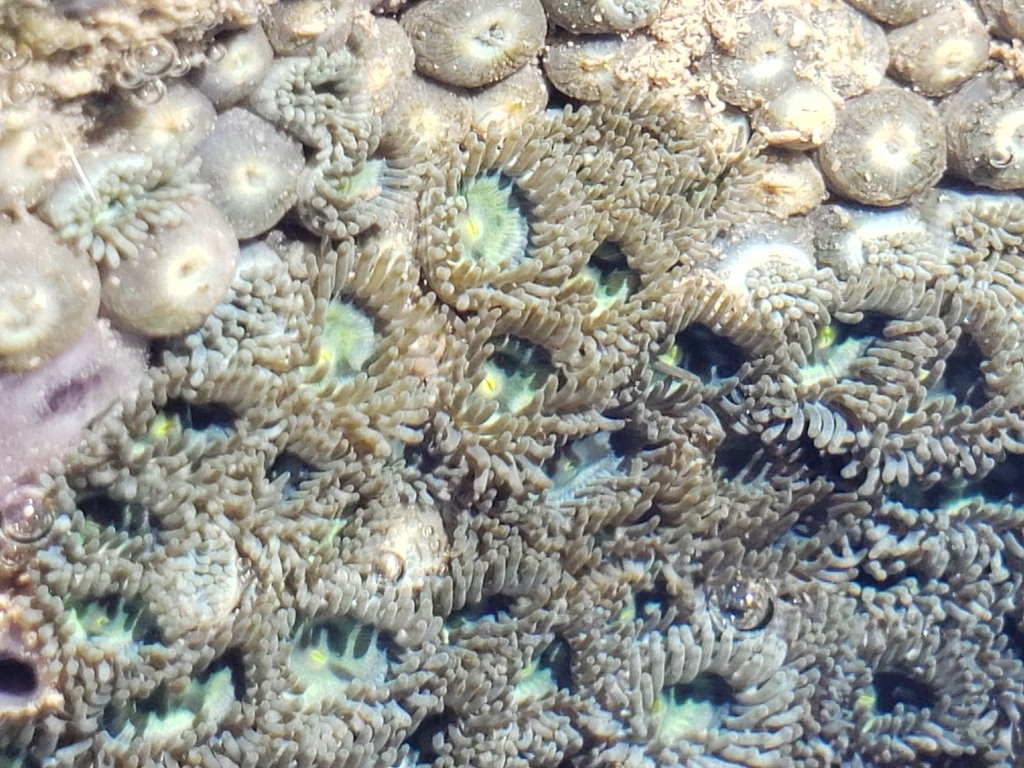
Zoanthids, or “zoas”, are button polyps sold in hundreds of named colour morphs. They are the gateway coral for many reefers.
| Scientific name | Zoanthus spp. and Palythoa spp. |
|---|---|
| Type | Soft coral (colonial polyps) |
| Origin | Tropical reefs worldwide |
| Lighting | Low to moderate |
| Water flow | Moderate |
| Placement | Lower to middle rockwork |
| Growth | Moderate to fast |
| Aggression | Low |
| Feeding | Photosynthetic; accept fine particulate foods |
| Water | 24 to 26°C, 1.025 to 1.026 SG, alkalinity 7 to 9 dKH, calcium 400 to 450 ppm, magnesium 1,300 to 1,400 ppm |
| Difficulty | Easy |
What it is like to keep
Zoanthids come in hundreds of named morphs, from cheap “palys” to collector colonies costing hundreds of pounds. The care is broadly the same: stable water, moderate light and steady flow. Most grow reasonably fast once settled, and a colony that opens every day with polyps stretched wide is a happy one.
Common problems are zoa pox (white spots on the column), zoa-eating nudibranchs and sea spiders. Dip every new frag in a reef dip, and inspect the base for tiny eggs before it goes in the tank.
Safety first: many zoanthids and especially Palythoa contain palytoxin, one of the most potent natural toxins. Wear gloves and eye protection when handling or fragging, never boil or pressure-wash rock with colonies on it, and wash hands thoroughly.
Placement, light and flow
Lower to middle rock with moderate light (roughly 100 to 200 PAR suits most). Too much light can bleach colours or make polyps stay small; too little and they stretch on long stalks. Moderate, indirect flow that gently moves the polyps is ideal.
Feeding
Photosynthetic, but they do capture fine particles. A weekly dose of fine coral food or rotifers can speed up growth. They also appreciate some nitrate and phosphate in the water; ultra-low nutrient systems often see zoas shrink.
Propagation and fragging
Cut a few polyps from the edge of a colony with a sharp scalpel, rinse off the slime, and glue the base to a frag plug with gel superglue. Wear gloves and safety glasses every time. New frags usually open within a few days.
Neighbours and compatibility
Fine with most fish. Keep them away from aggressive LPS such as hammers and torches, and from fast spreaders like GSP and Pulsing Xenia. Emerald crabs and some dwarf angels may pick at them.
Graham’s tip: Gloves and safety glasses every time. Palytoxin is no joke, and a squirt in the eye can put you in hospital.
More care sheets: Soft Corals. Questions? Ask in the comments below and I’ll answer.
Photo: lucas_rafaelle, CC BY-SA, via iNaturalist.
Get in touch I’d love to hear from you