
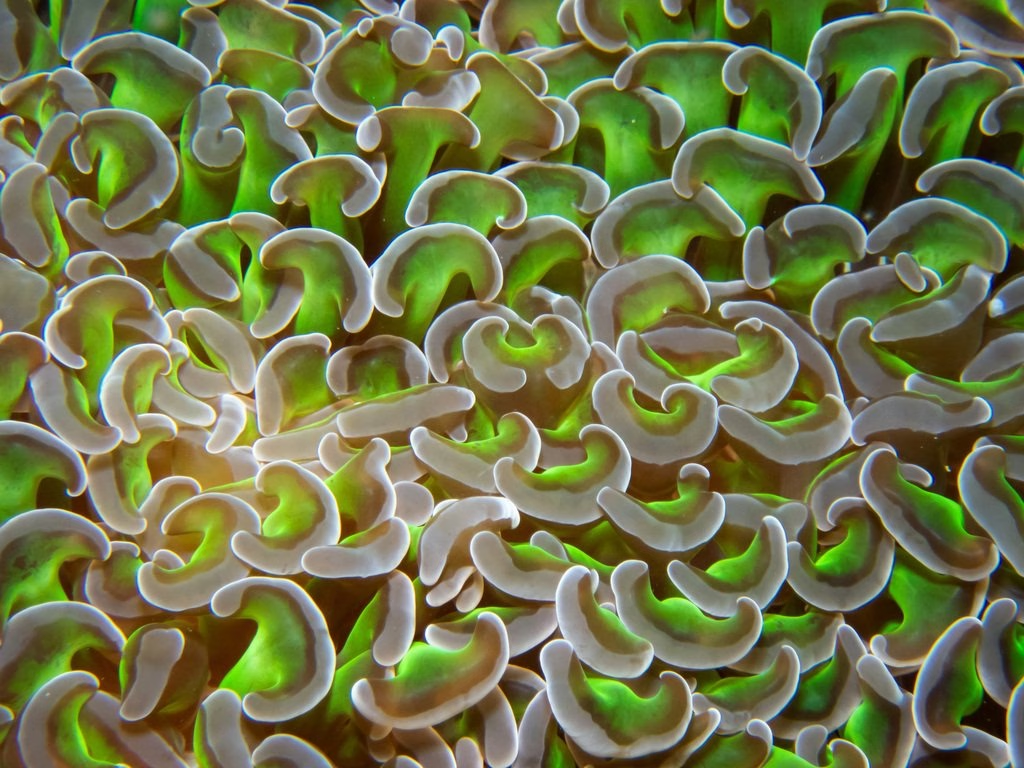
The hammer coral has tentacles tipped with hammer or anchor shapes, swaying in the current. It’s a favourite LPS.
| Scientific name | Fimbriaphyllia ancora (formerly Euphyllia ancora) |
|---|---|
| Type | LPS (large-polyp stony) |
| Origin | Indo-Pacific |
| Lighting | Moderate |
| Water flow | Moderate |
| Placement | Middle, with 15 cm clearance |
| Growth | Moderate |
| Aggression | Long sweeper tentacles sting neighbours |
| Feeding | Photosynthetic; occasional meaty foods |
| Water | 24 to 26°C, 1.025 to 1.026 SG, alkalinity 7 to 9 dKH, calcium 400 to 450 ppm, magnesium 1,300 to 1,400 ppm |
| Difficulty | Easy to moderate |
What it is like to keep
Hammers are among the most popular LPS, with tentacles tipped in hammer or anchor shapes in green, gold or purple. They come in wall forms (one long skeleton with a continuous fleshy edge) and branching forms (separate heads on stalks).
At night they extend long sweeper tentacles that sting any coral within reach. Give them at least 15 cm of space. Other Euphyllia (torches, frogspawn) are usually tolerated, but not always.
Hammers are prone to “brown jelly” infections if damaged. Remove any jelly with a turkey baster and dip the coral.
Placement, light and flow
Middle rock with moderate, indirect flow and moderate light (about 100 to 200 PAR). Too much flow makes them retract; too little leaves detritus on the tissue.
Feeding
Mainly photosynthetic. Occasional target feeding of small meaty foods (mysis, small pellets) once a week helps growth.
Propagation and fragging
Branching hammers are fragged by cutting between heads with a bone cutter or saw. Wall hammers can be cut with a wet saw, but it’s riskier.
Neighbours and compatibility
Keep 15 cm away from non-Euphyllia corals. Clownfish sometimes host in them; watch they don’t smother it.
Graham’s tip: Turn off the pumps at night once and watch the sweepers come out. You’ll know how much space it needs.
More care sheets: LPS Corals. Questions? Ask in the comments below and I’ll answer.
Photo: portioid, CC BY, via iNaturalist.
Get in touch I’d love to hear from you