
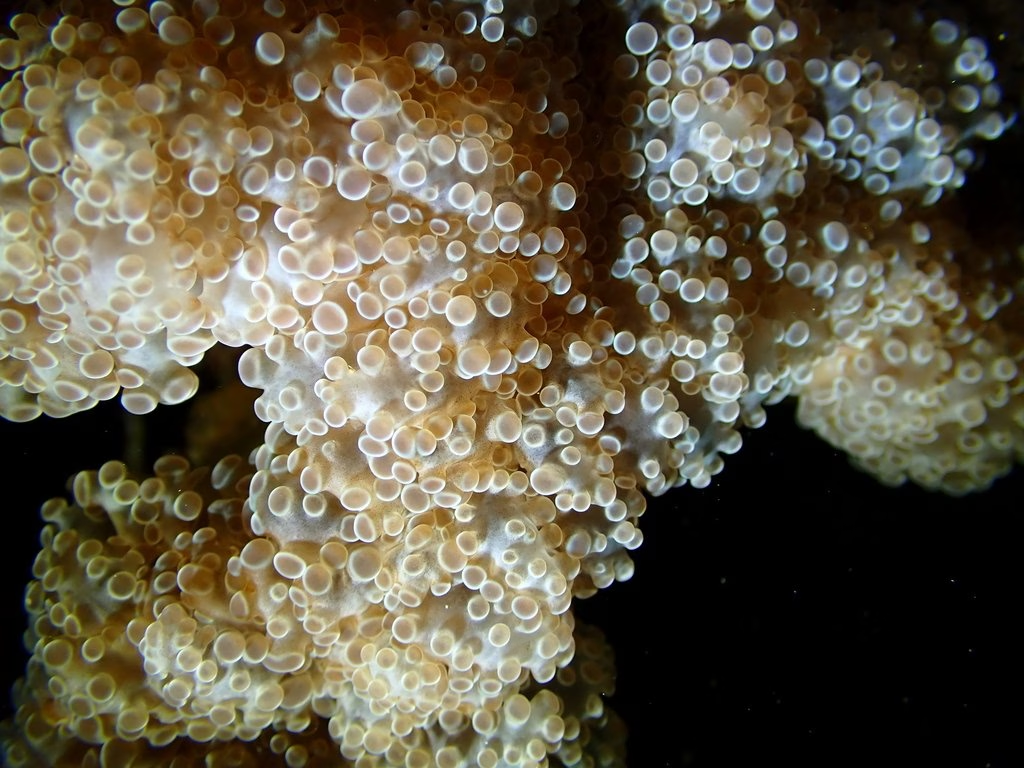
Frogspawn coral has branching tentacles that look like clusters of frog eggs. Easy and full of movement.
| Scientific name | Fimbriaphyllia divisa (formerly Euphyllia divisa) |
|---|---|
| Type | LPS |
| Origin | Indo-Pacific |
| Lighting | Moderate |
| Water flow | Moderate |
| Placement | Middle, with space |
| Growth | Moderate |
| Aggression | Long sweepers |
| Feeding | Photosynthetic; meaty foods |
| Water | 24 to 26°C, 1.025 to 1.026 SG, alkalinity 7 to 9 dKH, calcium 400 to 450 ppm, magnesium 1,300 to 1,400 ppm |
| Difficulty | Easy |
What it is like to keep
Frogspawn is the most forgiving Euphyllia, with tentacles that branch into little clusters like frog eggs. Green, gold and purple forms are common.
Like hammers and torches, it has night-time sweeper tentacles, so space matters. It’s an excellent first LPS.
Frogspawn is also less prone to the tissue-loss problems that have hit torches in recent years, though quarantine and a reef dip are still wise. A healthy colony is puffy, with tentacles extended most of the day; a frogspawn that stays shrunken usually has too much flow or is being stung by a neighbour.
Placement, light and flow
Middle rock with moderate light and indirect flow.
Feeding
Mainly photosynthetic. Occasional small meaty foods.
Propagation and fragging
Wall forms can be cut with a saw; branching forms split at the heads.
Neighbours and compatibility
Keep 15 cm from other corals except, usually, other Euphyllia.
Graham’s tip: Frogspawn is one of the most forgiving Euphyllia. A great first LPS.
More care sheets: LPS Corals. Questions? Ask in the comments below and I’ll answer.
Photo: Debra Baker, CC BY, via iNaturalist.
Get in touch I’d love to hear from you