
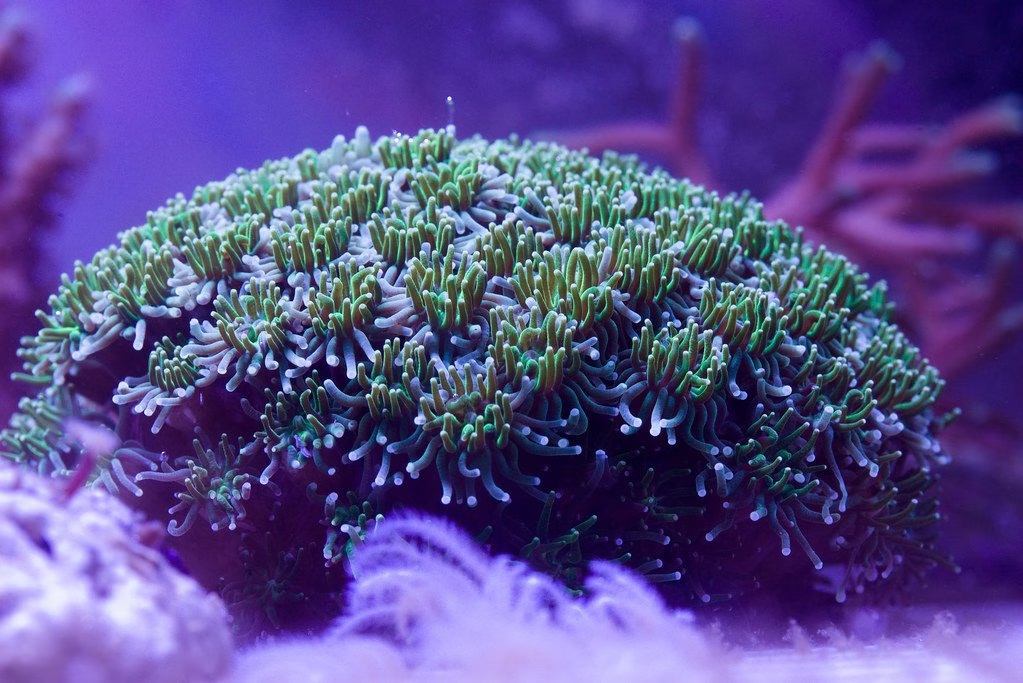
Green star polyps, or GSP, form a purple mat covered in fluorescent green polyps that wave in the current. It is nearly impossible to kill, which is both its charm and its curse.
| Scientific name | Briareum violaceum (often sold as Pachyclavularia) |
|---|---|
| Type | Soft coral (stoloniferan) |
| Origin | Indo-Pacific |
| Lighting | Low to high |
| Water flow | Moderate to strong |
| Placement | Isolated rock or the back glass, away from other corals |
| Growth | Very fast, spreads as a purple mat |
| Aggression | Low sting, but smothers neighbours |
| Feeding | Photosynthetic; no target feeding needed |
| Water | 24 to 26°C, 1.025 to 1.026 SG, alkalinity 7 to 9 dKH, calcium 400 to 450 ppm, magnesium 1,300 to 1,400 ppm |
| Difficulty | Very easy |
What it is like to keep
GSP is about as close to unkillable as reef corals get, which makes it a great confidence builder in a first reef. It shrugs off the nitrate and phosphate swings of a young tank, tolerates almost any light and grows under LEDs, T5s or old metal halides.
The flip side is speed. In a happy tank the purple mat can creep 2 to 3 cm a month across rock, and it will happily grow over the top of slower corals such as Zoanthids or Montipora. Polyps that stay closed for more than a day or two usually mean too little flow, a nuisance fish picking at them, or a film of algae on the mat.
Placement, light and flow
The classic trick is to let GSP cover the back glass or a sidewall, which hides equipment and turns the back of the tank into a waving green curtain. If you’d rather keep it on rock, use an isolated “island” rock surrounded by sand so it can’t bridge to the main reef. Moderate to strong, turbulent flow keeps the polyps open and stops detritus settling on the mat.
Feeding
Purely photosynthetic for practical purposes. It also absorbs dissolved nutrients, so it does well in tanks that aren’t ultra-low nutrient. Broadcast feeding for your fish is plenty; no target feeding needed.
Propagation and fragging
Easiest frag in the hobby. Peel or slice a strip of the purple mat with a razor blade or scissors, then hold it against a new rock or frag plug with a rubber band or a dab of gel superglue. It attaches within a week. You can also put a bare rock next to the colony and let it grow across.
Neighbours and compatibility
Peaceful with fish, shrimp and snails. Keep it well away from slow growers such as Acropora, Montipora and Zoanthids. Some rabbitfish and tangs nibble it occasionally, which is mostly harmless.
Graham’s tip: Grow GSP on a separate “island” rock. When it gets out of hand you lift the rock out, trim it and put it back.
More care sheets: Soft Corals. Questions? Ask in the comments below and I’ll answer.
Photo: rmhowie, CC BY-SA 2.0, via Flickr.
Get in touch I’d love to hear from you