
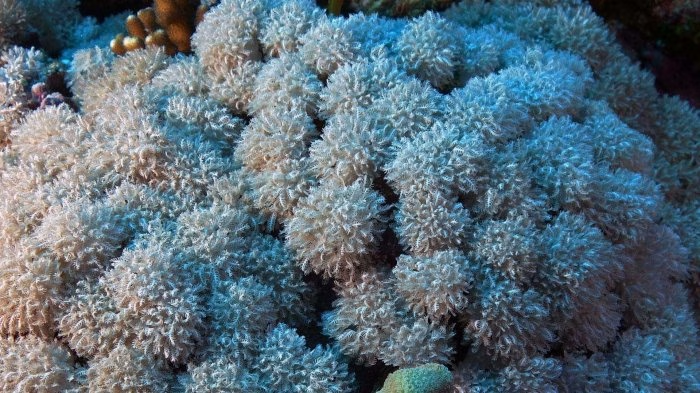
Pulsing xenia opens and closes its feathery hands rhythmically. Mesmerising, and in some tanks it takes over.
| Scientific name | Xenia spp. |
|---|---|
| Type | Soft coral |
| Origin | Indo-Pacific and Red Sea |
| Lighting | Moderate to high |
| Water flow | Low to moderate |
| Placement | Isolated rock |
| Growth | Very fast in some tanks |
| Aggression | Spreads rapidly |
| Feeding | Photosynthetic |
| Water | 24 to 26°C, 1.025 to 1.026 SG, alkalinity 7 to 9 dKH, calcium 400 to 450 ppm, magnesium 1,300 to 1,400 ppm |
| Difficulty | Easy (unpredictable) |
What it is like to keep
Pulsing xenia is famous for its “hands” that open and close rhythmically. Nobody is completely sure why it pulses, but it seems to help it exchange gases and nutrients.
It is also famously unpredictable. In some tanks xenia melts away within days for no clear reason; in others it spreads across every surface and becomes a pest. It tends to do best where there is a little nitrate and phosphate, and it appreciates stable iodine levels.
Placement, light and flow
Isolate it on its own rock (an island in the sand is ideal), with moderate light and low to moderate flow. Too strong a current stops the pulsing.
Feeding
Photosynthetic and absorbs nutrients. No target feeding needed.
Propagation and fragging
It splits and spreads on its own. To frag, cut a stalk at the base and hold it against rubble with a rubber band or mesh until it attaches.
Neighbours and compatibility
Fine with fish, though some dwarf angels and butterflyfish nibble it. Keep it well away from Zoanthids, acans and SPS it could overgrow.
Graham’s tip: Put xenia on an island rock. If it goes wild you’ll be glad you did.
More care sheets: Soft Corals. Questions? Ask in the comments below and I’ll answer.
Photo: ReefLifeApps.com, CC BY-SA 3.0, via Wikimedia Commons.
Get in touch I’d love to hear from you