
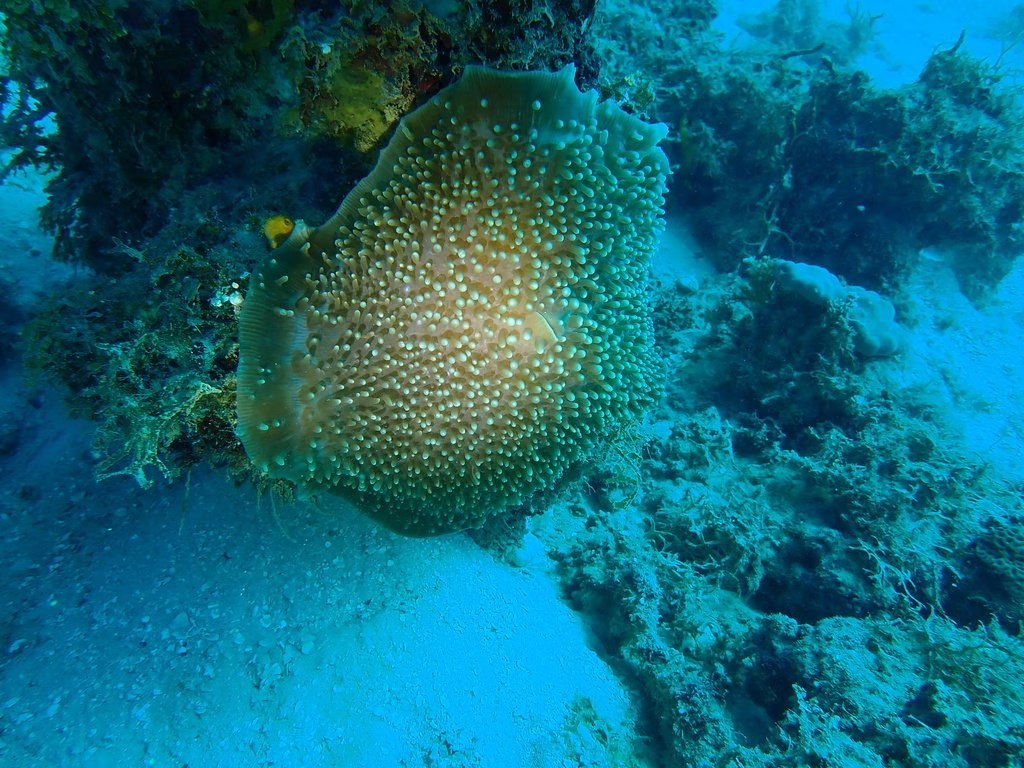
Mushroom corals are flat, disc-shaped polyps in every colour imaginable. They thrive in low light and are almost bulletproof.
| Scientific name | Discosoma and Rhodactis spp. |
|---|---|
| Type | Corallimorph |
| Origin | Indo-Pacific and Caribbean |
| Lighting | Low to moderate |
| Water flow | Low to moderate |
| Placement | Lower rockwork and shaded areas |
| Growth | Moderate |
| Aggression | Can overgrow neighbours |
| Feeding | Photosynthetic; take small meaty foods |
| Water | 24 to 26°C, 1.025 to 1.026 SG, alkalinity 7 to 9 dKH, calcium 400 to 450 ppm, magnesium 1,300 to 1,400 ppm |
| Difficulty | Very easy |
What it is like to keep
Mushrooms are corallimorphs, closer to anemones than true corals. They are ideal for beginners and for the shaded bits of a reef where other corals struggle. They come in every colour, including bubbly, striped, spotted and fluorescent forms.
They can wander slowly and multiply by splitting or dropping bits of tissue, so a single mushroom can become a whole rock in a year. If they start to shrink and look stringy, it usually means too much light or flow.
Placement, light and flow
Low to moderate light and gentle flow on lower rockwork or the sand bed. They don’t like to be blasted.
Feeding
Photosynthetic. Small pieces of mysis or a pinch of pellet dropped onto the disc will speed growth; they close around food quickly.
Propagation and fragging
Many split on their own. To speed it up, slice a mushroom into two or three wedges with a scalpel and hold each piece in a small container with rubble until it attaches.
Neighbours and compatibility
Fine with fish. They can sting and overgrow slower corals, so keep them away from SPS and Zoanthids. Some lionfish and triggers may eat them.
Graham’s tip: If mushrooms shrink and look stringy, the light is too strong. Move them lower.
More care sheets: Soft Corals. Questions? Ask in the comments below and I’ll answer.
Photo: Debra Baker, CC BY, via iNaturalist.
Get in touch I’d love to hear from you