
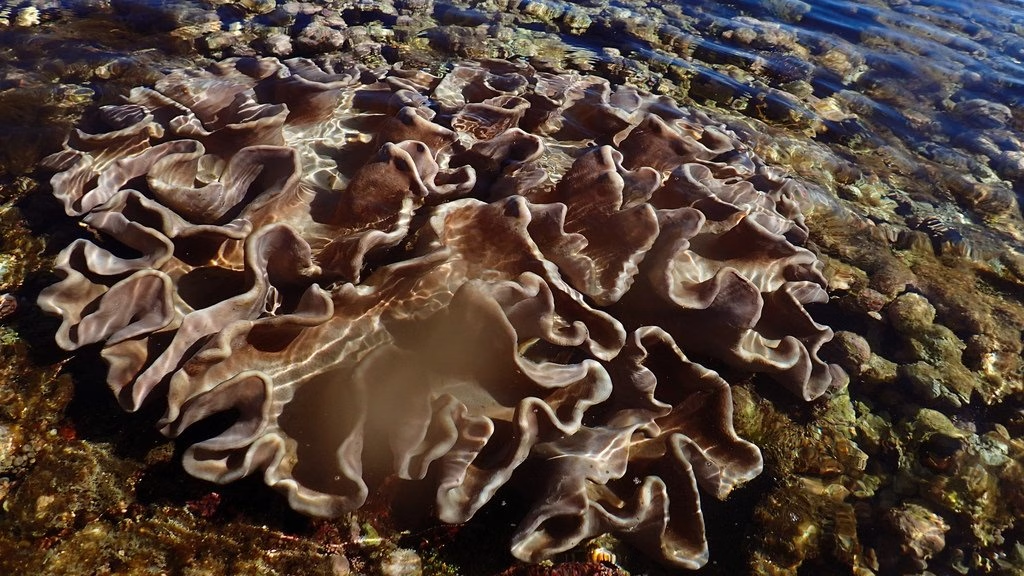
The toadstool leather is a mushroom-shaped soft coral with a flat cap covered in polyps. It is hardy and can grow very large. This Toadstool Leather Coral care sheet covers everything you need to keep one well.
| Scientific name | Sarcophyton spp. |
|---|---|
| Type | Soft coral (leather) |
| Origin | Indo-Pacific |
| Lighting | Moderate to high |
| Water flow | Moderate to strong |
| Placement | Middle rock with space around it |
| Growth | Fast, can become large |
| Aggression | Releases chemicals (terpenes) that affect other corals |
| Feeding | Photosynthetic |
| Water | 24 to 26°C, 1.025 to 1.026 SG, alkalinity 7 to 9 dKH, calcium 400 to 450 ppm, magnesium 1,300 to 1,400 ppm |
| Difficulty | Easy |
What it is like to keep
Toadstools are tough, fast-growing soft corals that can reach 30 cm across. They are an excellent first coral because they tolerate the wobbles of a young tank.
Every few weeks they close up for a few days and shed a waxy skin. This is normal. Turning up the flow helps them shed. They also release chemicals (terpenes) to fight off neighbours, so run activated carbon if you keep several leathers or a mixed reef.
Placement, light and flow
Middle rock with moderate to strong flow and moderate to high light. Allow room to grow.
Feeding
Photosynthetic. No target feeding needed.
Propagation and fragging
Cut a wedge from the cap with a sharp blade, then rubber-band or glue it to rock. It will heal and form a new toadstool.
Neighbours and compatibility
Fine with fish. Keep space between leathers and SPS or LPS, and run carbon.
Graham’s tip: If your toadstool stays closed for a week, check for a waxy film. Turn up the flow and it’ll shed and open.
More care sheets: Soft Corals. Questions? Ask in the comments below and I’ll answer.
Photo: Cheng-Tao Lin, CC BY, via iNaturalist.
Get in touch I’d love to hear from you