
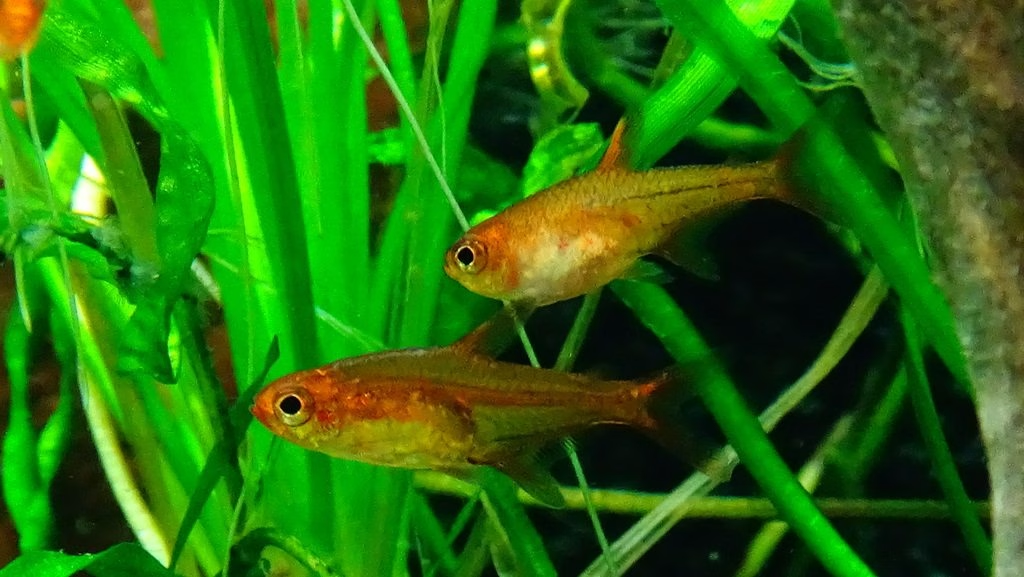
Ember tetras are tiny orange sparks that look best in a heavily planted tank. At barely two centimetres they suit nano tanks, but they are tougher than their size suggests.
| Scientific name | Hyphessobrycon amandae |
|---|---|
| Family | Characidae |
| Origin | Araguaia river basin, Brazil |
| Adult size | 2 cm |
| Lifespan | 2 to 4 years |
| Minimum tank | 40 litres |
| Temperature | 24 to 28°C |
| pH | 5.5 to 7.0 |
| Hardness | Soft to medium, 1 to 12 dGH |
| Swims in | Middle |
| Temperament | Peaceful |
| Group size | 10 or more |
| Diet | Omnivore: crushed flake, micro pellets, baby brine shrimp |
| Difficulty | Easy |
What it is like to keep
Embers are one of my go-to recommendations for a first nano. They are captive-bred in large numbers, settle quickly and colour up within a week. A big group spreads out across the tank rather than shoaling tightly, which suits a planted aquascape.
Setting up the tank
Plants, plants, plants. A dark substrate and floating cover make the orange glow. Gentle filtration is fine; a sponge filter on a 40 to 60 litre tank is ideal. Keep the temperature stable and the water clean.
Feeding
Crushed flake and micro pellets daily, with frozen cyclops or baby brine shrimp a few times a week. Feed small amounts so food doesn’t rot in the plants.
Breeding
Egg scatterers. In a mature planted tank with moss you will see the odd fry survive. For more, move a group to a small tank with java moss, then remove the adults after spawning and feed infusoria.
Tank mates
Great with chilli rasboras, Pygmy Corydoras, Otocinclus, celestial pearl danios, sparkling gouramis and shrimp. Too small for angelfish or anything with a big mouth.
Graham’s tip: If your embers look washed out, it is almost always stress or bright bare surroundings. Add floating plants before you blame the food.
More care sheets: Species Profiles. Questions? Ask in the comments below and I’ll answer.
Photo: Cedricguppy – Loury Cédric, CC BY-SA, via iNaturalist.
Get in touch I’d love to hear from you