
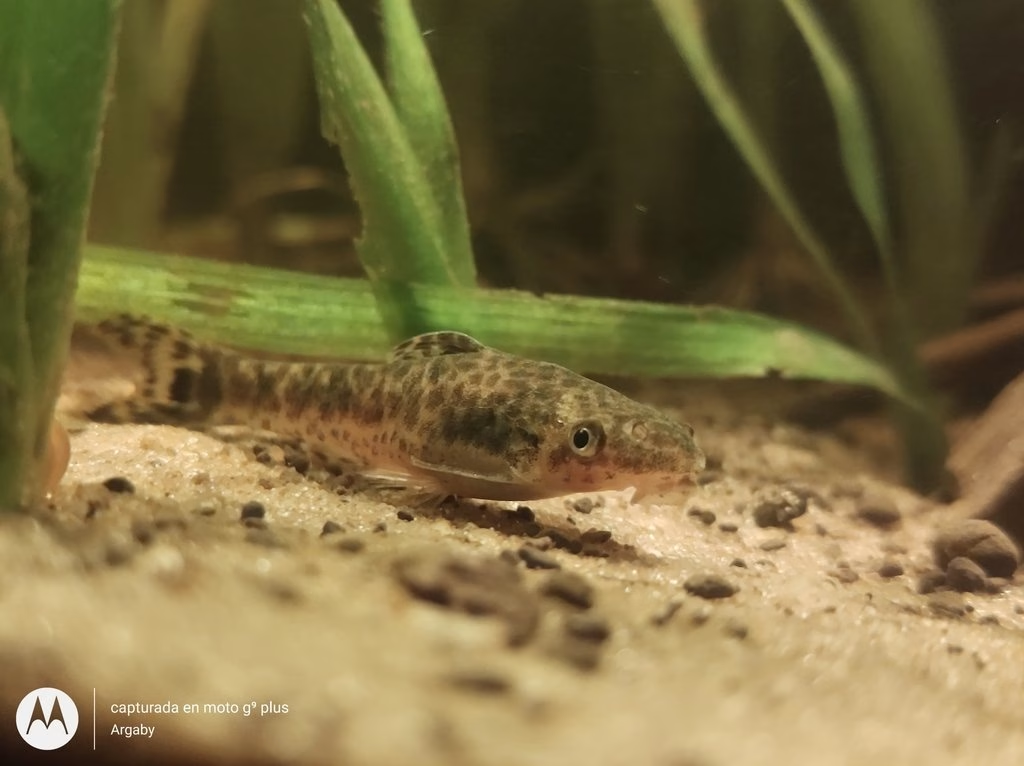
The otocinclus, or “oto”, is a tiny sucker-mouth catfish that grazes soft algae and biofilm from plants and glass. It is a planted-tank favourite.
| Scientific name | Otocinclus spp. (mainly O. vittatus and O. macrospilus) |
|---|---|
| Family | Loricariidae |
| Origin | South America |
| Adult size | 4 cm |
| Lifespan | 3 to 5 years |
| Minimum tank | 60 litres |
| Temperature | 22 to 26°C |
| pH | 6.0 to 7.5 |
| Hardness | Soft to medium |
| Swims in | Bottom and on surfaces |
| Temperament | Peaceful |
| Group size | 6 or more |
| Diet | Herbivore: soft algae, biofilm, algae wafers, blanched courgette |
| Difficulty | Moderate |
What it is like to keep
Most otos are wild-caught and arrive half-starved. Add them only to mature tanks with algae and biofilm, and feed vegetables as well.
Setting up the tank
A mature, planted tank with plenty of surfaces covered in biofilm. Stable, clean water.
Feeding
Natural biofilm and soft algae, with algae wafers and blanched courgette or cucumber to top up.
Breeding
Rare at home; they lay eggs on leaves and glass.
Tank mates
Ideal with small tetras, rasboras, corydoras, honey gouramis and shrimp.
Graham’s tip: Check bellies before you buy. A rounded belly means a fed fish. Sunken ones rarely recover.
More care sheets: Species Profiles. Questions? Ask in the comments below and I’ll answer.
Photo: Gabriel Albelda, CC BY, via iNaturalist.
Get in touch I’d love to hear from you