
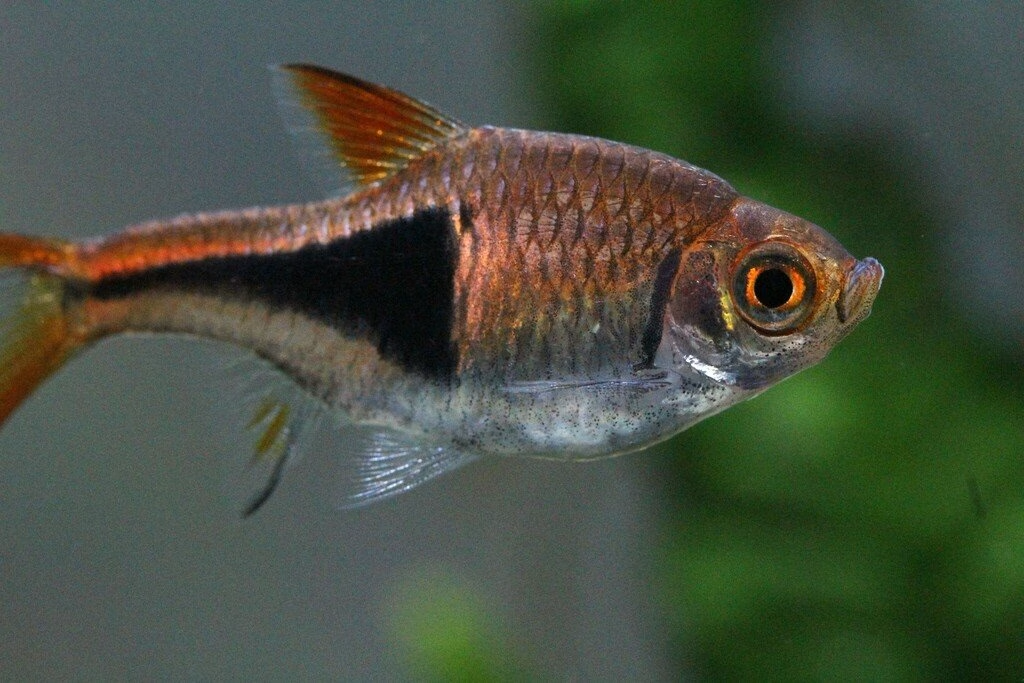
The harlequin rasbora is a copper-orange fish with a black triangular patch. It is one of the most dependable shoaling fish for a planted community tank.
| Scientific name | Trigonostigma heteromorpha |
|---|---|
| Family | Danionidae |
| Origin | Malaysia, Singapore, southern Thailand and Sumatra |
| Adult size | 4.5 cm |
| Lifespan | 5 to 8 years |
| Minimum tank | 60 litres |
| Temperature | 22 to 27°C |
| pH | 5.0 to 7.5 |
| Hardness | Soft to medium, up to 12 dGH |
| Swims in | Middle |
| Temperament | Peaceful |
| Group size | 8 or more |
| Diet | Omnivore: flake, micro pellets, frozen foods |
| Difficulty | Easy |
What it is like to keep
Harlequins are hardy, peaceful and shoal more tightly than most tetras, especially with a few larger tank mates around. Captive-bred fish adapt to a wide range of water.
Setting up the tank
Planted tank with dark substrate, some floating plants and broad-leaved plants such as Cryptocoryne. Gentle to moderate flow.
Feeding
Flake and micro pellets with frozen daphnia, cyclops and bloodworm.
Breeding
Unusual among rasboras: they lay eggs on the underside of broad leaves. Soft acidic water (around 2 to 4 dGH, pH 6) and Cryptocoryne or Anubias in a spawning tank give the best chance. See my harlequin breeding article.
Tank mates
Excellent with tetras, corydoras, dwarf and honey gouramis, kuhli loaches, Otocinclus and shrimp.
Graham’s tip: They are a great test of a tank. Harlequins shoaling tightly and coloured up means the water is good. Pale and hanging about means check your parameters.
More care sheets: Species Profiles. Questions? Ask in the comments below and I’ll answer.
Photo: -serwacy01-, CC BY-SA, via iNaturalist.
Get in touch I’d love to hear from you