
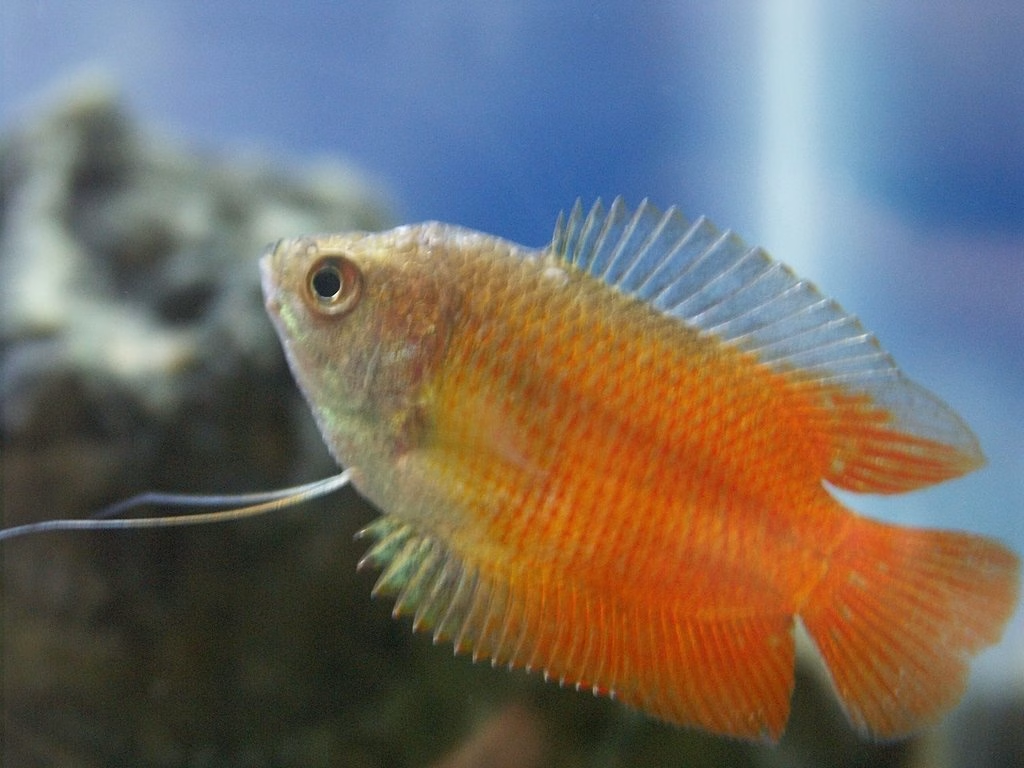
The dwarf gourami is a stunning little labyrinth fish, males striped red and blue (or solid powder blue and flame red in bred forms). Sadly, mass-farmed stock carries a serious disease risk.
| Scientific name | Trichogaster lalius |
|---|---|
| Family | Osphronemidae |
| Origin | India, Bangladesh, Pakistan |
| Adult size | 6 to 8 cm |
| Lifespan | 3 to 5 years |
| Minimum tank | 60 litres |
| Temperature | 24 to 28°C |
| pH | 6.0 to 7.5 |
| Hardness | Up to 15 dGH |
| Swims in | Top to middle |
| Temperament | Peaceful, males territorial to each other |
| Group size | 1 male, or 1 male with 2 females |
| Diet | Omnivore: flake, small pellets, frozen foods, vegetable matter |
| Difficulty | Moderate |
What it is like to keep
Many farmed dwarf gouramis carry Dwarf Gourami Iridovirus (DGIV), which is incurable. Buy from a shop that quarantines and avoid fish that look thin, blotchy or lethargic. Once settled, they are peaceful and charming.
Setting up the tank
Planted tank with floating plants, gentle flow and a warm, stable temperature. Keep only one male unless the tank is large.
Feeding
Flake, small pellets, frozen bloodworm and brine shrimp, plus some vegetable matter.
Breeding
Males build bubble nests among floating plants. Remove the female after spawning; the male guards eggs until fry swim.
Tank mates
Good with harlequins, tetras, corydoras, kuhli loaches and Otocinclus. Avoid fin nippers and other gouramis.
Graham’s tip: If you want the look with less risk, the honey gourami is tougher and more reliably healthy.
More care sheets: Species Profiles. Questions? Ask in the comments below and I’ll answer.
Photo: Fred Hsu, CC BY-SA, via iNaturalist.
Get in touch I’d love to hear from you