
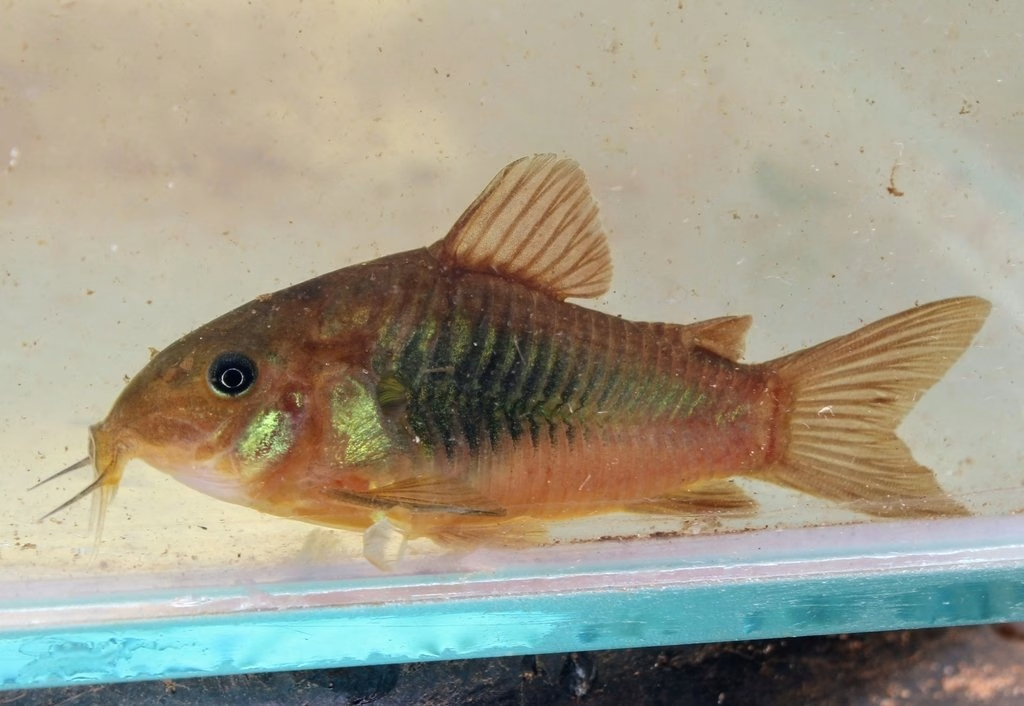
The bronze cory is the classic “cleaner” catfish, a metallic green-bronze armoured cat that snuffles the substrate in busy little groups. Albino forms are the same species. This Bronze Corydoras care sheet covers everything you need to keep one well.
| Scientific name | Corydoras aeneus |
|---|---|
| Family | Callichthyidae |
| Origin | Widespread across South America |
| Adult size | 7 cm |
| Lifespan | 5 to 10 years |
| Minimum tank | 60 litres |
| Temperature | 22 to 26°C |
| pH | 6.0 to 8.0 |
| Hardness | Up to 20 dGH |
| Swims in | Bottom |
| Temperament | Peaceful |
| Group size | 6 or more |
| Diet | Omnivore: sinking pellets and wafers, frozen bloodworm |
| Difficulty | Easy |
What it is like to keep
Corys are social. One or two alone are stressed; six or more are relaxed and active. They are not cleaners: they need their own food.
Setting up the tank
Sand or very smooth fine gravel is essential: sharp gravel wears down their barbels. Some cover and open sandy areas.
Feeding
Sinking pellets and wafers, frozen bloodworm and brine shrimp. Feed after lights out if faster fish steal food.
Breeding
They lay sticky eggs on glass and plants after a cool water change. Remove eggs to a separate tank to raise.
Tank mates
Good with almost any peaceful community fish: tetras, rasboras, livebearers, gouramis, Angelfish and bristlenose.
Graham’s tip: Swap gravel for sand and watch your corys change. They spend all day sifting it through their gills, and it’s far better for their barbels.
More care sheets: Species Profiles. Questions? Ask in the comments below and I’ll answer.
Photo: Douglas Lopes, CC BY, via iNaturalist.
Get in touch I’d love to hear from you