
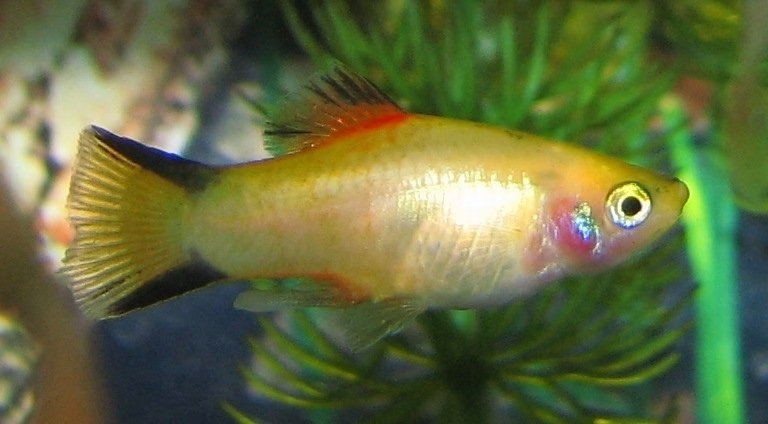
Platies are bright, chunky livebearers that come in almost every colour you can think of. They are cheerful, easy and ideal for a first community tank. This Platy care sheet covers everything you need to keep one well.
| Scientific name | Xiphophorus maculatus |
|---|---|
| Family | Poeciliidae |
| Origin | Atlantic slope of Mexico, Guatemala and Belize |
| Adult size | 6 cm |
| Lifespan | 3 to 4 years |
| Minimum tank | 60 litres |
| Temperature | 20 to 26°C |
| pH | 7.0 to 8.2 |
| Hardness | Medium to hard, 10 to 25 dGH |
| Swims in | All levels |
| Temperament | Peaceful |
| Group size | 3 or more, 1 male to 2 or 3 females |
| Diet | Omnivore: flake, pellets, vegetable matter, frozen foods |
| Difficulty | Very easy |
What it is like to keep
Platies love hard, alkaline water, so most UK tap water suits them perfectly. Females give birth roughly every four weeks, so expect babies whether you want them or not.
Setting up the tank
Planted community tank with some floating plants for fry cover. Moderate flow. Not fussy.
Feeding
Flake, pellets and lots of vegetable matter: spirulina flake, blanched peas or courgette. They graze algae too.
Breeding
Livebearers. Females drop 20 to 80 fry about every 28 days. Floating plants or a breeding box save some from being eaten.
Tank mates
Good with mollies, swordtails, danios, corydoras, black neons and bristlenose.
Graham’s tip: If you don’t want hundreds of platies, keep only one sex, or add a predator like a Kribensis to keep numbers in check.
More care sheets: Species Profiles. Questions? Ask in the comments below and I’ll answer.
Photo: Ltshears, CC BY-SA, via iNaturalist.
Get in touch I’d love to hear from you