
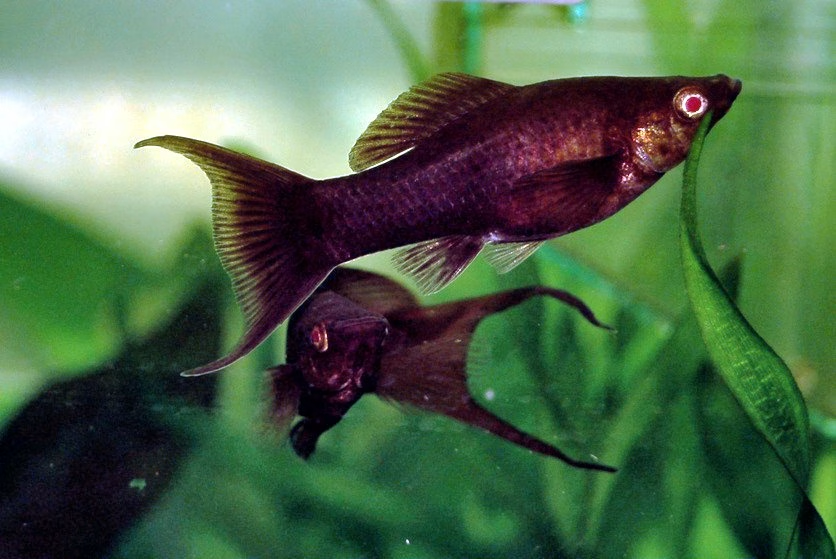
Mollies are big, friendly livebearers: black, dalmatian, gold, balloon and sailfin varieties are all the same few species. They are much fussier about water than shops often admit. This Molly care sheet covers everything you need to keep one well.
| Scientific name | Poecilia sphenops and P. latipinna hybrids |
|---|---|
| Family | Poeciliidae |
| Origin | Mexico to Colombia (sphenops); south-east USA (latipinna) |
| Adult size | 8 to 12 cm |
| Lifespan | 3 to 5 years |
| Minimum tank | 100 litres |
| Temperature | 24 to 28°C |
| pH | 7.5 to 8.5 |
| Hardness | Hard, 15 to 30 dGH |
| Swims in | All levels |
| Temperament | Peaceful |
| Group size | 1 male to 2 or 3 females |
| Diet | Herbivore-leaning omnivore: spirulina flake, vegetables, pellets |
| Difficulty | Moderate |
What it is like to keep
Mollies need hard, alkaline water. In soft water they get “the shimmies” and fall ill. Many keepers add a little aquarium salt, but in genuinely hard water it isn’t needed. They can also adapt to brackish and even full marine water over time.
Setting up the tank
A 100 litre or larger tank with hard water, good filtration and plenty of plant matter to graze. Avoid cool tanks.
Feeding
Mostly vegetable: spirulina flake, blanched spinach, courgette and peas, plus some pellets and frozen food. They graze algae all day.
Breeding
Livebearers. Females give birth to 20 to 100 fry about every 60 days. Sailfin males need warm, spacious tanks to develop full fins.
Tank mates
Good with platies, swordtails, danios, bristlenose and other hard-water fish.
Graham’s tip: Test your general hardness before buying mollies. If your water is soft, choose a different fish. You won’t win that fight.
More care sheets: Species Profiles. Questions? Ask in the comments below and I’ll answer.
Photo: Marrabbio, CC BY-SA, via iNaturalist.
Get in touch I’d love to hear from you