
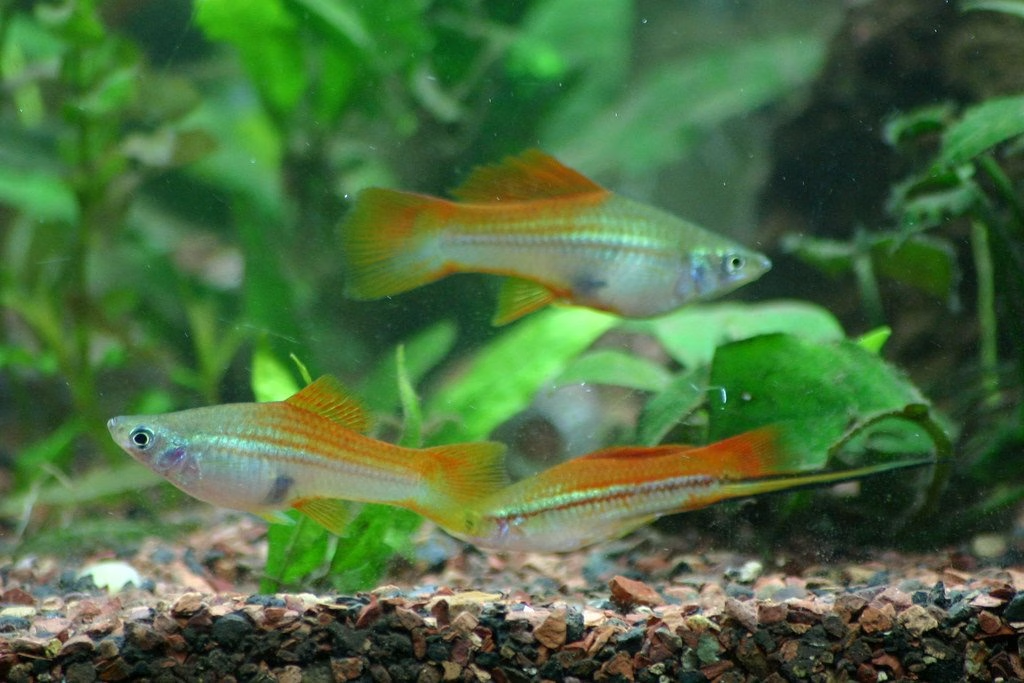
The swordtail is a larger cousin of the Platy, with males carrying a long sword-like extension on the lower tail. Red, green, black and pineapple forms are all common.
| Scientific name | Xiphophorus hellerii |
|---|---|
| Family | Poeciliidae |
| Origin | Mexico to Honduras, Central America |
| Adult size | 12 cm (male plus sword), 14 cm (female) |
| Lifespan | 3 to 5 years |
| Minimum tank | 100 litres |
| Temperature | 22 to 28°C |
| pH | 7.0 to 8.3 |
| Hardness | Medium to hard, 12 to 30 dGH |
| Swims in | All levels |
| Temperament | Peaceful, males can be pushy |
| Group size | 1 male to 3 females |
| Diet | Omnivore: flake, pellets, vegetable matter, frozen foods |
| Difficulty | Easy |
What it is like to keep
Swordtails are active swimmers and males can harass females and each other. Keep one male with several females, or several males in a larger tank so no one gets singled out. They like hard water and will jump, so use a lid.
Setting up the tank
At least 100 litres, ideally longer, with planted areas and open swimming water. Floating plants give fry cover.
Feeding
Flake and pellets with plenty of vegetable matter and some frozen foods.
Breeding
Livebearers. Females drop 20 to 100 fry every four to six weeks. Adults will eat the young, so dense plants help.
Tank mates
Good with platies, mollies, danios, corydoras, bristlenose and peaceful barbs.
Graham’s tip: Swordtails grow bigger than shop fish suggest. Plan your tank around a 12 to 14 cm fish, not the 4 cm one in the bag.
More care sheets: Species Profiles. Questions? Ask in the comments below and I’ll answer.
Photo: Genista, CC BY-SA 2.0, via Flickr.
Get in touch I’d love to hear from you