
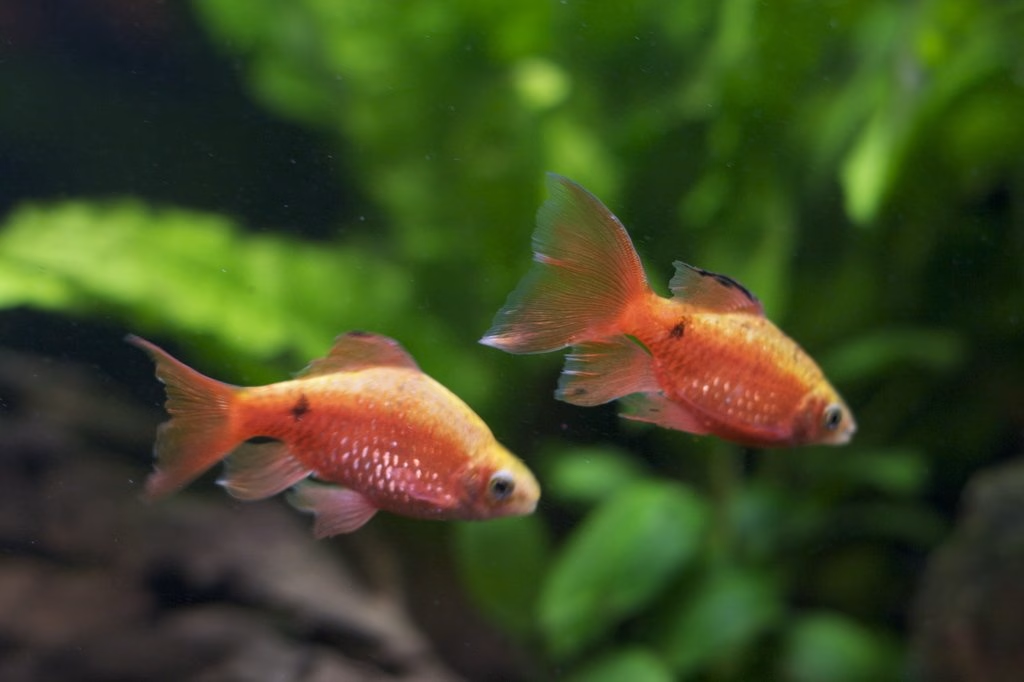
The rosy barb is a hardy, active fish whose males flush deep pink-red in breeding colour. It tolerates cooler water and is one of the toughest community fish going.
| Scientific name | Pethia conchonius |
|---|---|
| Family | Cyprinidae |
| Origin | Northern India, Nepal, Bangladesh, Pakistan |
| Adult size | 10 cm |
| Lifespan | 5 years |
| Minimum tank | 120 litres |
| Temperature | 18 to 25°C |
| pH | 6.0 to 8.0 |
| Hardness | Up to 20 dGH |
| Swims in | All levels |
| Temperament | Peaceful, active |
| Group size | 6 or more |
| Diet | Omnivore: flake, pellets, frozen foods, vegetables |
| Difficulty | Very easy |
What it is like to keep
Rosies are robust and good-natured but busy, and they grow larger than most people expect. They do well in cooler or unheated tanks in a warm room.
Setting up the tank
A long tank with swimming room and hardy plants; they will nibble soft ones. Good filtration.
Feeding
Flake, pellets, frozen foods and vegetable matter such as blanched spinach or courgette.
Breeding
Easy egg scatterers. Remove the adults after spawning in a planted spawning tank.
Tank mates
Good with danios, gold barbs, loaches, bristlenose, corydoras and other robust fish.
Graham’s tip: If you are running a cooler tank around 20°C, rosies are one of the few colourful options that stay healthy at that temperature.
More care sheets: Species Profiles. Questions? Ask in the comments below and I’ll answer.
Photo: Kkonstan, CC BY, via iNaturalist.
Get in touch I’d love to hear from you