

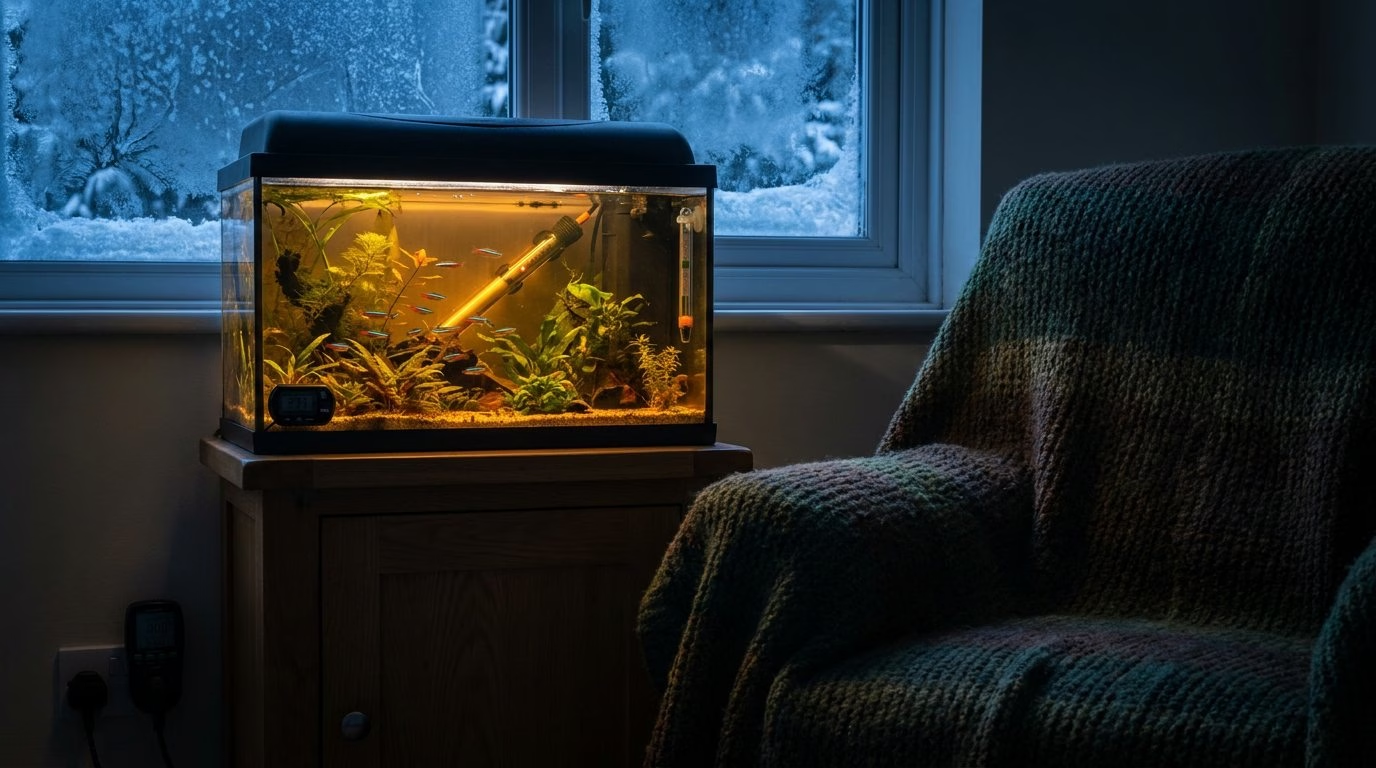
The short answer: a typical 100 to 125 litre tropical tank in a UK living room costs roughly 20p to 35p a day to heat in winter, so somewhere around £6 to £10.50 a month for the heater alone. Where it lands depends on three things: how cold the room gets, whether your tank has a lid, and how warm you keep the water. Get those right and you can knock a third or more off the bill without your fish ever noticing.
Every November my inbox fills up with the same question in different words: “Graham, my electricity bill’s gone through the roof, is it the fish tank?” Sometimes it is. Usually it’s the tumble dryer. Let’s find out which.
How much does an aquarium heater actually use?
Here’s the bit people get wrong. The number printed on your heater (100 W, 150 W, 200 W) is how much it draws while it’s switched on. It isn’t on all the time. The thermostat clicks it on when the water dips, and off again when it’s back up to temperature. In a warm summer room it might run for an hour a day. On a frosty January night with the central heating off, a lot more.
So the sum is: wattage × hours it’s actually on ÷ 1,000 = kWh per day. Multiply that by your unit rate (it’s on your bill, in pence per kWh) and you have your daily cost.
Rough winter figures, worked out at 26p per kWh. Swap in your own rate; the maths is the same.
| Tank size | Typical heater | Hours on per day (winter, room 16 to 18 °C) | kWh per day | Cost per day | Cost per month |
|---|---|---|---|---|---|
| 60 litres | 75 W | 6 to 10 | 0.45 to 0.75 | 12p to 20p | £3.50 to £6 |
| 100 to 125 litres | 150 W | 5 to 9 | 0.75 to 1.35 | 20p to 35p | £6 to £10.50 |
| 200 litres | 2 × 100 W | 6 to 10 | 1.2 to 2.0 | 31p to 52p | £9.50 to £16 |
| 250 litre reef | 2 × 150 W | 5 to 9 | 1.5 to 2.7 | 39p to 70p | £12 to £21 |
These are honest estimates, not lab numbers. Your tank will differ. The only way to know for sure is to measure it, which brings me to the best tenner you’ll spend this winter.
Measure it: get a plug-in energy monitor
A plug-in energy meter sits between the wall socket and your tank’s extension lead, and tells you exactly how many kWh everything on that lead has used. Plug it in, leave it a full week, divide by seven. Done. No guesswork, and it settles the “is it the fish tank?” argument at home once and for all.
Buy one with a cost display where you type in your unit rate. Something like this: plug-in energy monitors on Amazon.
While you’re at it, note what the rest of the kit costs. A 10 W filter running 24 hours is 0.24 kWh a day, about 6p. A 20 W LED light on for 8 hours is 0.16 kWh, about 4p. In winter the heater is nearly always the big one.
What size heater do you need?
The old rule of thumb is 1 watt per litre. That’s fine in a centrally heated house. For a tank in a cold room, a conservatory, a garage or a fish house, go nearer 1.5 to 2 watts per litre.
| Tank volume | Warm room (19 °C+) | Cool room (15 to 18 °C) | Cold room (below 15 °C) |
|---|---|---|---|
| Up to 30 litres | 25 W | 50 W | 50 W |
| 60 litres | 50 to 75 W | 100 W | 100 to 150 W |
| 100 to 125 litres | 100 to 150 W | 150 to 200 W | 200 W or 2 × 100 W |
| 200 litres | 200 W or 2 × 100 W | 2 × 150 W | 2 × 200 W |
| 300 litres+ | 2 × 150 W | 2 × 200 W | 2 × 300 W |
Myth: “A bigger heater costs more to run”
No, it doesn’t. Graham says no. Heating 100 litres from 18 °C to 25 °C takes the same amount of energy whether you use a 100 W heater or a 300 W one. The big one just gets there faster and switches off sooner. What decides your bill is how much heat the tank loses, not the size of the heater.
The real problem with an oversized heater is safety. If its thermostat sticks on, a 300 W heater in a 60 litre tank can cook your fish in a few hours. Which is why, for anything over about 150 litres, I’d always use two smaller heaters instead of one big one. If one sticks on, it isn’t powerful enough to overheat the tank on its own. If one dies, the other keeps the chill off.
8 ways to cut your tank’s heating bill (without risking your fish)
- Put a lid on it. This is the big one. Most heat leaves a tank through the surface, as evaporation. An open-top tank in a dry, centrally heated room loses heat and water all day long. A lid, or even a sheet of clear acrylic or glass cut to size, makes a huge difference. If you’re topping up a lot, you’re paying to heat water that’s going up the walls.
- Insulate the back and sides. Stick a sheet of polystyrene or foil-backed insulation board to the back glass, behind your background. Nobody sees it, and the back of a tank against an outside wall is where heat bleeds away. For fish houses and breeding racks, insulate the sides and underneath too.
- Move it away from windows, doors and outside walls. Yes, I can see the irony in the photo at the top of this page. A tank next to single glazing or a draughty back door is fighting the weather all night. An inside wall is cheaper and the temperature swings are smaller. It’s also better for algae, as a bonus.
- Turn it down a degree or two, within your fish’s range. Most community fish are perfectly happy at 24 °C rather than 27 °C. Each degree you drop cuts the gap between tank and room, and with it the heat lost. Check your species first: neons, corys, platies and most tetras are fine at 24 °C; discus, rams and some marine set-ups are not. Our water parameters guide lists safe ranges.
- Check your heater’s thermostat is telling the truth. Cheap heater dials can be out by 2 or 3 degrees. Use a separate digital thermometer. I’ve met plenty of people “saving money” at 25 °C who were actually running at 28 °C.
- Use an external heater controller. A plug-in thermostat controller with its own probe takes over from the heater’s built-in thermostat. It holds the temperature more accurately (less overshoot, less waste) and cuts the power if the water gets too hot. On reef tanks and big tanks, I consider one essential. Aquarium heater controllers on Amazon.
- Keep the room steady, not the tank cold. The heating in your house is far cheaper per degree than the heater in your tank. If you have a room thermostat, the tank room is the last place to let drop to 12 °C overnight.
- Look at what else is running. Old fluorescent tubes and halides use far more than modern LEDs, and an air pump you don’t really need is a few pence a day for nothing. A timer plug on the lights stops them being left on all night.
Myth: “Switch the heater off at night to save money”
Please don’t. Graham says no. Tropical fish come from water that barely changes temperature between day and night. Letting the tank drop several degrees overnight and then heating it back up every morning stresses fish, and stressed fish get ill. A temperature swing is one of the classic triggers for whitespot. And you save far less than you’d think, because the heater just works harder in the morning to win the heat back. Steady and slightly cooler beats up-and-down every time.
Heater safety: the winter checklist
Winter is when heaters work hardest, so it’s when they fail. A few minutes now saves a lot of heartache.
- Unplug the heater before every water change. A glass heater that’s hot when the water level drops can crack when cold water hits it. See our water changes guide.
- After refilling, wait 15 to 20 minutes before switching it back on, so the heater’s thermostat can match the water.
- Use a drip loop on every cable: let it hang below the socket so water runs off the bottom of the loop, not down into the plug.
- Plug everything into an RCD-protected socket or adaptor. If anything leaks current into the water, the RCD cuts it in a split second. If your house doesn’t have one on that circuit, a plug-in RCD adaptor costs a few quid.
- Fit a heater guard if you keep plecos, loaches or big cichlids. They’ll lean on a heater and burn themselves.
- Replace heaters every few years. Thermostats wear. If yours is over five years old and does a lot of work, a spare in the cupboard is cheap insurance. Aquarium heaters on Amazon.
- Check the temperature every day. It takes two seconds. A stuck heater or a dead one shows up on the thermometer long before it shows up in the fish.
What about marine and reef tanks?
Reef tanks are usually the most expensive tanks to run in winter. Not because of the heater alone, but because of the bigger water volume, the sump, and the pumps running round the clock. The good news: those pumps put a bit of heat into the water themselves, which lightens the heater’s load a little. The same rules apply: lid or cover on the sump, insulate where you can, two heaters with a controller, and hold the temperature steady. Corals hate swings far more than they hate 25 °C instead of 26 °C. More in our reef tank set-up guide.
And if the power goes off?
Winter storms bring power cuts. A healthy tank will be fine for a few hours: wrap it in a duvet, don’t feed, and keep air going into the water. I’ve written a full guide to power cuts and your aquarium, including the £30 kit that means you won’t panic next time.
Can I just go coldwater instead?
Some fish don’t need a heater at all in a normal UK house. White Cloud Mountain Minnows are happy at room temperature, and so are many shrimp (see shrimp and snails). If your bill is a real worry and you’re planning a new tank, it’s worth a thought. Just don’t take the heater out of a tropical tank to save money. The fish pay for that one.
Quick checklist: cheaper winter heating
- Lid on, top-ups down
- Insulation board on the back glass
- Tank away from windows and outside doors
- Set 24 °C for most community fish (check your species)
- Separate thermometer to check the heater dial
- Two smaller heaters on big tanks, ideally on a controller
- Never switch the heater off at night
- Measure a week with an energy monitor, then decide
Related reading: Aquarium kit guide · Water parameters explained · Stocking guide · Best beginner fish · Fish Health Clinic
What does your tank cost to run? If you’ve measured it, tell me the tank size, room and the number in the comments. I’ll build a proper table from your real readings. — Graham
Some links on this page are affiliate links (ad). As an Amazon Associate I earn from qualifying purchases, at no extra cost to you. Costs are estimates at 26p per kWh, November 2026; check your own tariff.

Get in touch I’d love to hear from you