
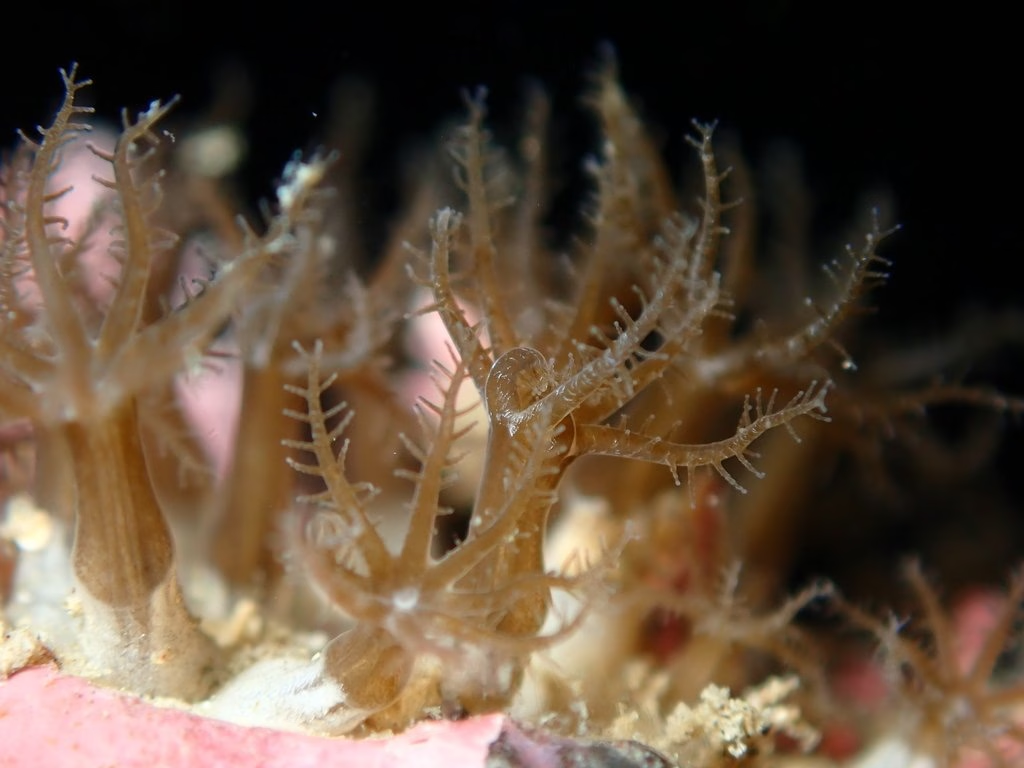
Clove polyps have feathery eight-tentacled polyps. They’re easy and spread quickly.
| Scientific name | Clavularia spp. |
|---|---|
| Type | Soft coral (stoloniferan) |
| Origin | Indo-Pacific |
| Lighting | Low to moderate |
| Water flow | Moderate |
| Placement | Lower rock |
| Growth | Fast |
| Aggression | Spreads |
| Feeding | Photosynthetic |
| Water | 24 to 26°C, 1.025 to 1.026 SG, alkalinity 7 to 9 dKH, calcium 400 to 450 ppm, magnesium 1,300 to 1,400 ppm |
| Difficulty | Easy |
What it is like to keep
Clove polyps are small stoloniferan soft corals with feathery, eight-tentacled polyps connected by runners across the rock. They are related to green star polyps and share the same hardiness and fast growth.
They are a great way to soften rubble zones or the base of a rockscape. Like GSP, they will spread onto neighbouring corals, so plan their place.
Placement, light and flow
Lower rock or rubble with low to moderate light and moderate flow. They retract when blasted by strong flow.
Feeding
Photosynthetic. Occasional fine foods are taken but not needed.
Propagation and fragging
Cut a section of the runner mat and attach it to a new rock with a rubber band or glue.
Neighbours and compatibility
Fine with fish. Keep them away from slower corals such as Zoanthids and SPS.
Graham’s tip: They look great as a carpet on rubble at the bottom of the tank.
More care sheets: Soft Corals. Questions? Ask in the comments below and I’ll answer.
Photo: Luca Davenport-Thomas, CC BY, via iNaturalist.
Get in touch I’d love to hear from you