
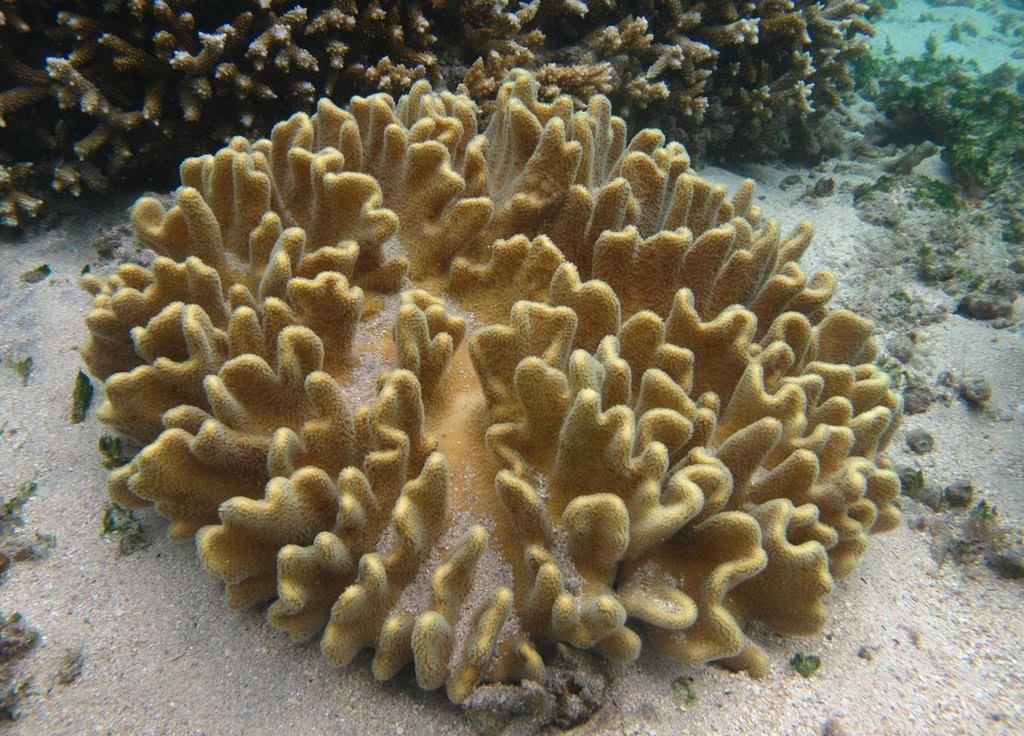
The devil’s hand leather has lobes that look like fingers on a hand. It’s tough and easy to keep.
| Scientific name | Lobophytum spp. |
|---|---|
| Type | Soft coral (leather) |
| Origin | Indo-Pacific |
| Lighting | Moderate to high |
| Water flow | Moderate |
| Placement | Middle rock |
| Growth | Moderate |
| Aggression | Releases chemicals |
| Feeding | Photosynthetic |
| Water | 24 to 26°C, 1.025 to 1.026 SG, alkalinity 7 to 9 dKH, calcium 400 to 450 ppm, magnesium 1,300 to 1,400 ppm |
| Difficulty | Easy |
What it is like to keep
The devil’s hand leather grows as a thick, lobed base with finger-like ridges, usually cream, tan or green, covered in short polyps. It grows more slowly than toadstools and finger leathers, which makes it easier to manage in a mixed reef.
Like all leathers it fights neighbours chemically, releasing terpenes that can stunt nearby stony corals. It also sheds a waxy skin every few weeks and stays closed while it does; a burst of stronger flow helps it shed.
Placement, light and flow
Middle rock with moderate light (about 100 to 250 PAR) and moderate, turbulent flow. Leave 10 to 15 cm of space around it to allow for growth.
Feeding
Photosynthetic. It absorbs dissolved nutrients, so it doesn’t need target feeding and does well where nitrate and phosphate are not bottomed out.
Propagation and fragging
Slice off a lobe or a strip of the edge with a sharp blade, then rubber-band it to a rock or hold it in a rubble-filled cup until it attaches, usually within two weeks.
Neighbours and compatibility
Fine with fish and invertebrates. Run activated carbon and keep it away from SPS such as Acropora and Montipora.
Graham’s tip: Leathers are great for beginners because they forgive the swings new tanks go through.
More care sheets: Soft Corals. Questions? Ask in the comments below and I’ll answer.
Photo: Philippe Bourjon, CC BY-SA, via iNaturalist.
Get in touch I’d love to hear from you