
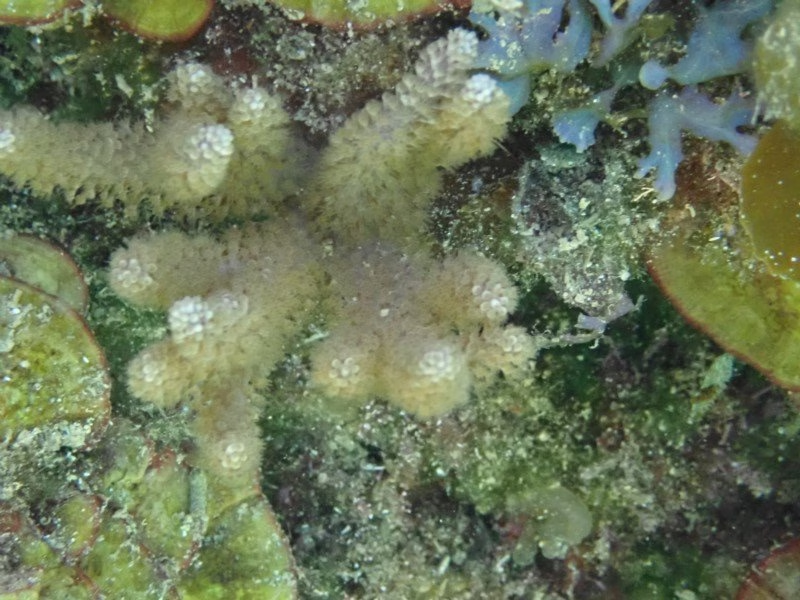
The Kenya tree is a branching soft coral that grows like a small tree. Hardy, but it spreads. This Kenya Tree Coral care sheet covers everything you need to keep one well.
| Scientific name | Capnella spp. |
|---|---|
| Type | Soft coral |
| Origin | Indo-Pacific |
| Lighting | Low to moderate |
| Water flow | Moderate |
| Placement | Lower to middle rock |
| Growth | Fast, drops branches that root elsewhere |
| Aggression | Can spread widely |
| Feeding | Photosynthetic |
| Water | 24 to 26°C, 1.025 to 1.026 SG, alkalinity 7 to 9 dKH, calcium 400 to 450 ppm, magnesium 1,300 to 1,400 ppm |
| Difficulty | Very easy |
What it is like to keep
The Kenya tree is a soft coral that grows like a little brown or green tree, with branches covered in small polyps. It is extremely tolerant of beginner mistakes and grows quickly.
Its growth habit is the catch: Kenya trees “drop” small branches that drift off and root wherever they land. In a few months one colony can become a dozen. Some keepers love this; others consider it a pest. Plan for it, and pick up fallen branches before they root among your prized corals.
Placement, light and flow
Lower to middle rock with low to moderate light and moderate flow. It copes with a wide range of conditions and some nutrients in the water.
Feeding
Photosynthetic. No target feeding needed.
Propagation and fragging
It propagates itself. To take a frag deliberately, snip off a branch and rubber-band it to rubble; it roots within a couple of weeks.
Neighbours and compatibility
Fine with fish. Keep it away from slow growers such as Zoanthids, acans and SPS, and run carbon in a mixed reef.
Graham’s tip: Pick up dropped branches before they root somewhere you don’t want them.
More care sheets: Soft Corals. Questions? Ask in the comments below and I’ll answer.
Photo: libby hepburn, CC BY, via iNaturalist.
Get in touch I’d love to hear from you