
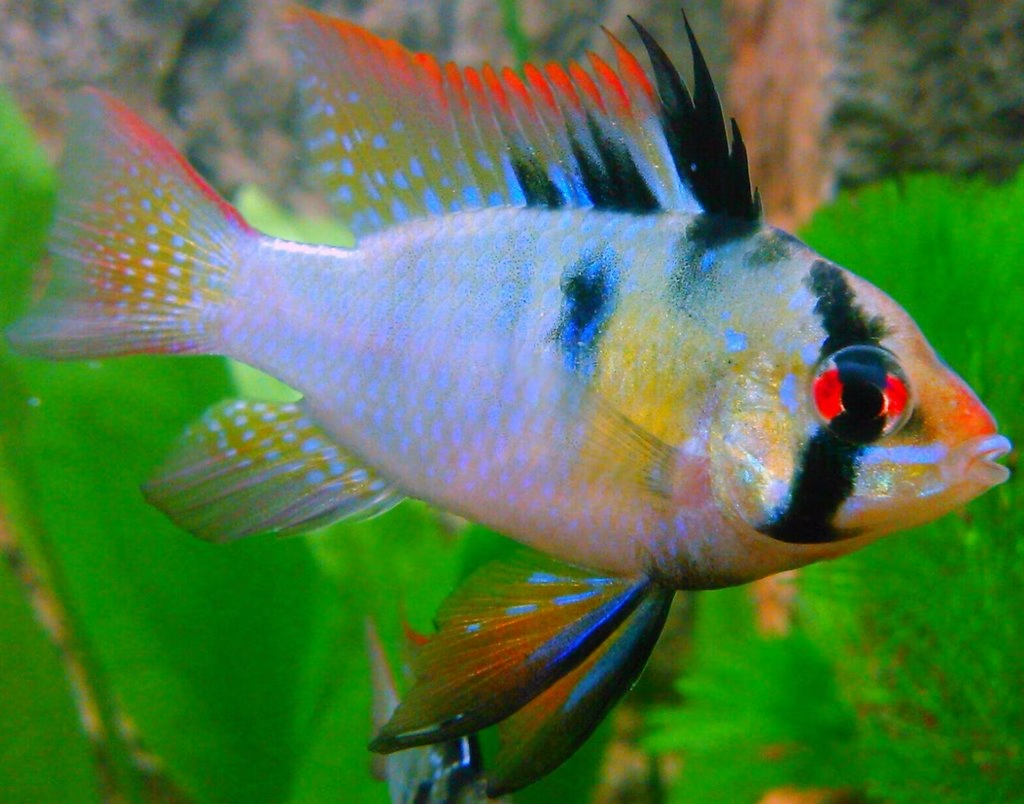
The German blue ram is a jewel of a dwarf cichlid, electric blue spangles over yellow and gold with a red eye. It is also one of the more delicate fish sold to beginners.
| Scientific name | Mikrogeophagus ramirezi |
|---|---|
| Family | Cichlidae |
| Origin | Orinoco basin, Venezuela and Colombia |
| Adult size | 5 to 7 cm |
| Lifespan | 2 to 4 years |
| Minimum tank | 60 litres |
| Temperature | 27 to 30°C |
| pH | 5.0 to 7.0 |
| Hardness | Soft, under 8 dGH |
| Swims in | Bottom to middle |
| Temperament | Peaceful, territorial when breeding |
| Group size | Pair |
| Diet | Omnivore: small pellets, frozen bloodworm, brine shrimp |
| Difficulty | Moderate to advanced |
What it is like to keep
Rams need warm, soft, very clean water and a mature tank. Poor-quality farmed stock is common, so buy from a shop you trust and look for plump, active fish with good colour. Once settled, a pair is endlessly watchable.
Setting up the tank
A planted tank of 60 litres or more with sand, wood and leaf litter, kept at 28°C. Gentle flow and stable, low-nitrate water.
Feeding
Small sinking pellets and granules, frozen bloodworm, brine shrimp and daphnia. Feed small amounts two or three times a day.
Breeding
Pairs clean a flat stone and lay up to 300 eggs. Both parents guard eggs and fry. Soft acidic water improves hatch rates.
Tank mates
Good with cardinals, rummynoses, sterbai corys, Otocinclus and Discus. Avoid boisterous barbs.
Graham’s tip: Rams are a “second tank” fish. Get a tank stable for six months first, then add them, and you’ll have far more success.
More care sheets: Species Profiles. Questions? Ask in the comments below and I’ll answer.
Photo: Aquakeeper14, CC BY-SA, via iNaturalist.
Get in touch I’d love to hear from you