
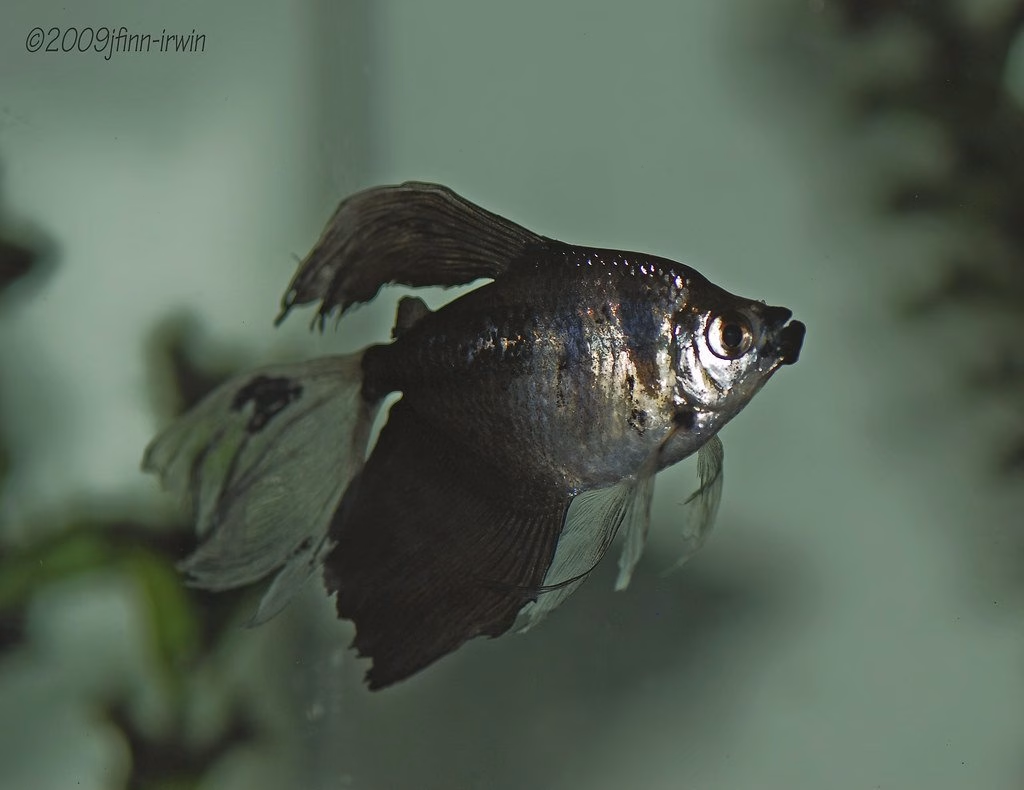
The black widow, or black skirt tetra, is a deep-bodied fish with a flowing black anal fin. It is cheap, tough and widely available, which is why it turns up in so many starter tanks. This Black Widow Tetra care sheet covers everything you need to keep one well.
| Scientific name | Gymnocorymbus ternetzi |
|---|---|
| Family | Characidae |
| Origin | Paraguay and Guaporé basins, South America |
| Adult size | 6 cm |
| Lifespan | 3 to 5 years |
| Minimum tank | 80 litres |
| Temperature | 22 to 27°C |
| pH | 6.0 to 8.0 |
| Hardness | Up to 20 dGH |
| Swims in | Middle to top |
| Temperament | Peaceful, can nip fins |
| Group size | 6 or more |
| Diet | Omnivore: flake, pellets, frozen foods |
| Difficulty | Easy |
What it is like to keep
Black widows are hardy and adaptable, but kept in small numbers they can become nippy. In a group of six or more they keep each other busy. They lose their black colour gradually with age, which is normal.
Setting up the tank
A medium community tank with plants around the edges and swimming room in the middle. They are not fussy about water chemistry.
Feeding
Flake and small pellets daily, plus frozen bloodworm or brine shrimp as treats.
Breeding
Egg scatterers. Condition a pair, move them to a spawning tank with fine-leaved plants, and remove them once eggs are laid. Fry take infusoria then baby brine shrimp.
Tank mates
Fine with platies, zebra danios, corydoras, bristlenose plecos and robust barbs. Avoid long-finned fish such as bettas, Angelfish and fancy guppies.
Graham’s tip: Skip the dyed or “glofish” versions. The natural fish is handsome enough and you don’t want to support dyeing.
More care sheets: Species Profiles. Questions? Ask in the comments below and I’ll answer.
Get in touch I’d love to hear from you