
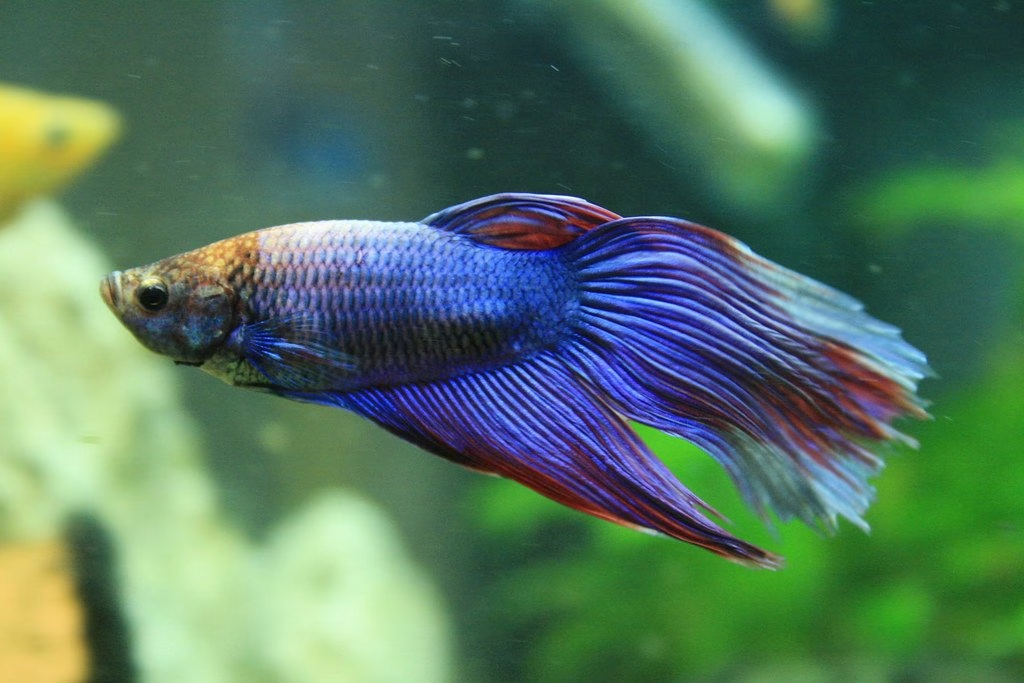
The betta, or Siamese fighting fish, is the most misunderstood fish in the shops. Those cups are not a home. Given a heated, filtered, planted tank a betta becomes a curious, interactive pet with real personality.
| Scientific name | Betta splendens |
|---|---|
| Family | Osphronemidae |
| Origin | Thailand, Cambodia, Laos, Vietnam |
| Adult size | 6 to 7 cm |
| Lifespan | 3 to 5 years |
| Minimum tank | 20 litres (30 plus preferred) |
| Temperature | 24 to 28°C |
| pH | 6.0 to 7.5 |
| Hardness | Soft to medium |
| Swims in | Top |
| Temperament | Males aggressive to other males and lookalikes |
| Group size | Males alone |
| Diet | Carnivore: betta pellets, frozen bloodworm, brine shrimp, daphnia |
| Difficulty | Easy |
What it is like to keep
Males must be kept alone or with carefully chosen peaceful tank mates. They breathe air using a labyrinth organ, so they need access to the surface. They are poor swimmers with long fins and hate strong currents.
Setting up the tank
At least 20 litres, heated to 26°C, with a gentle filter (a sponge filter is perfect), plenty of plants and a lid. Indian almond leaves and floating plants make them feel at home.
Feeding
Quality betta pellets, with frozen bloodworm, brine shrimp and daphnia a few times a week. Don’t overfeed; a betta’s stomach is the size of its eye.
Breeding
The male builds a bubble nest. Spawning needs a separate set-up and lots of planning for fry and rehoming the males.
Tank mates
In 40 litres or more: corydoras, ember tetras, harlequins, Otocinclus, kuhli loaches and nerite snails. Never with other bettas, gouramis, tiger barbs or fancy guppies.
Graham’s tip: If your betta’s fins are tattered, check the filter flow before you blame disease. A baffle or sponge over the outlet fixes half the “fin rot” I see.
More care sheets: Species Profiles. Questions? Ask in the comments below and I’ll answer.
Photo: h080, CC BY-SA 2.0, via Flickr.
Get in touch I’d love to hear from you