
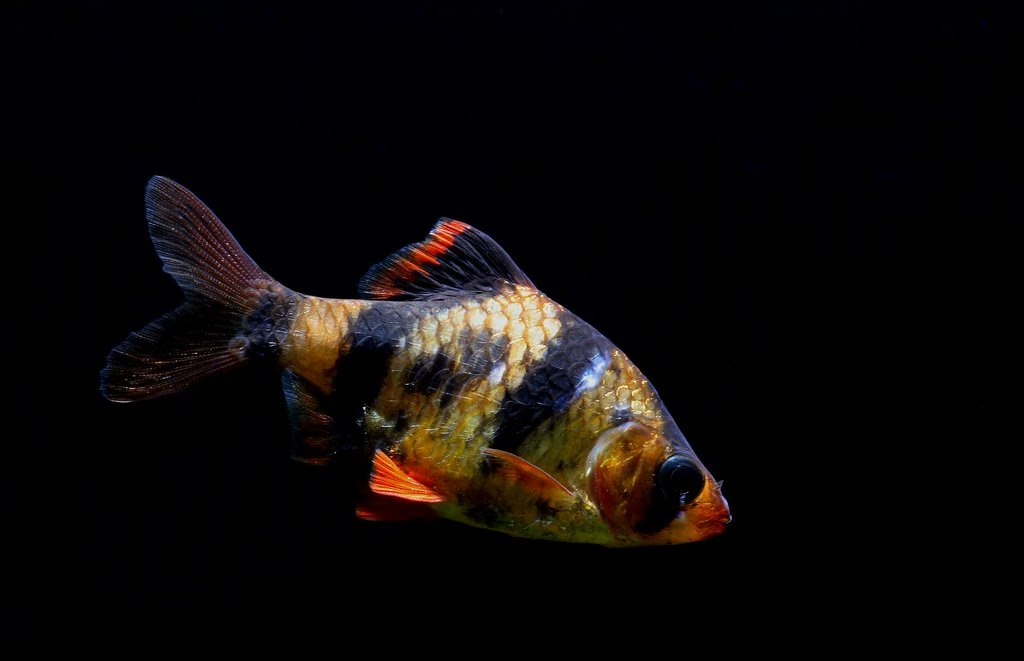
The tiger barb is a bold orange and black striped fish with red fins. It is lively and hardy, and it is the fish most people mean when they warn you about fin nippers. For the green variant, see my green tiger barb page.
| Scientific name | Puntigrus tetrazona |
|---|---|
| Family | Cyprinidae |
| Origin | Sumatra and Borneo |
| Adult size | 7 cm |
| Lifespan | 5 to 7 years |
| Minimum tank | 100 litres |
| Temperature | 22 to 26°C |
| pH | 6.0 to 8.0 |
| Hardness | Up to 19 dGH |
| Swims in | Middle |
| Temperament | Semi-aggressive, notorious fin nipper |
| Group size | 8 or more |
| Diet | Omnivore: flake, pellets, frozen foods, vegetable matter |
| Difficulty | Easy |
What it is like to keep
The secret is numbers. In a group of eight or more the nipping and chasing stays inside the shoal. In threes or fours they turn on everything else in the tank.
Setting up the tank
Long tank with plenty of open swimming room and some planted cover. Good filtration and oxygenation.
Feeding
Flake and pellets with frozen bloodworm, brine shrimp and some vegetable flake or blanched peas.
Breeding
Egg scatterers. A conditioned pair in a spawning tank with fine plants, with the adults removed after spawning.
Tank mates
Fast, robust fish: danios, serpaes, black widows, clown loaches, corydoras and plecos. Never with Angelfish, bettas or gouramis.
Graham’s tip: A big shoal of tigers in a tank on their own with some catfish is a fantastic display. They are only a problem when we mix them with the wrong fish.
More care sheets: Species Profiles. Questions? Ask in the comments below and I’ll answer.
Photo: Anandarajkumar, CC BY-SA, via iNaturalist.
Get in touch I’d love to hear from you