
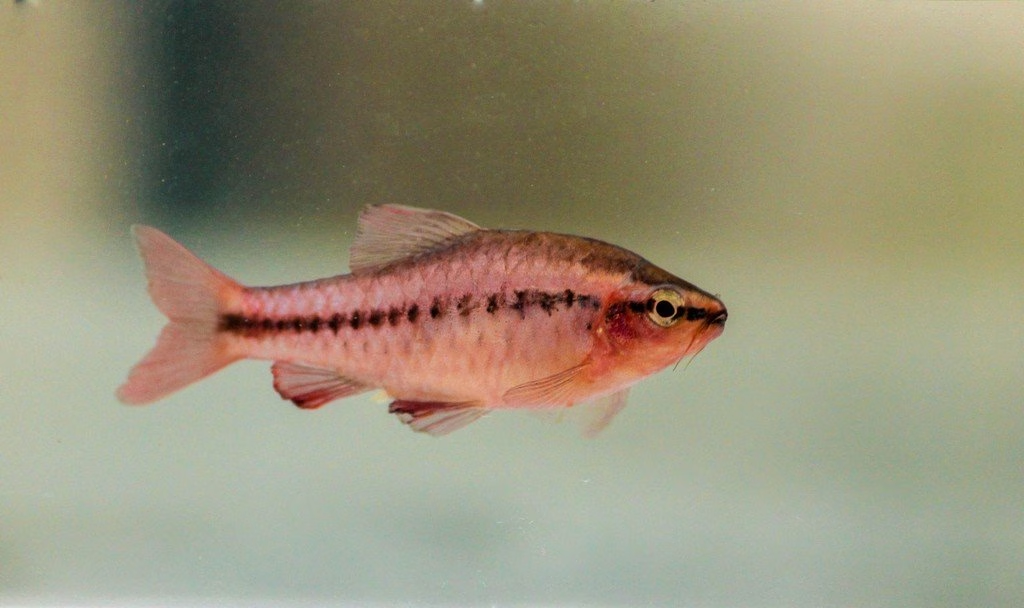
The cherry barb is the gentle barb. Males turn a deep cherry red, there is no fin nipping, and it fits easily into a planted community tank.
| Scientific name | Rohanella titteya |
|---|---|
| Family | Cyprinidae |
| Origin | Sri Lanka |
| Adult size | 5 cm |
| Lifespan | 5 to 7 years |
| Minimum tank | 60 litres |
| Temperature | 23 to 27°C |
| pH | 6.0 to 7.5 |
| Hardness | Up to 15 dGH |
| Swims in | Lower to middle |
| Temperament | Peaceful |
| Group size | 6 or more |
| Diet | Omnivore: flake, micro pellets, frozen foods, vegetable matter |
| Difficulty | Easy |
What it is like to keep
Unlike tiger barbs, cherries are calm and slightly shy. They prefer the lower half of the tank among plants. Males display to each other constantly, and their colour intensifies when females are around.
Setting up the tank
Planted tank with subdued light, floating plants and a dark substrate. Moderate flow.
Feeding
Flake, micro pellets, frozen bloodworm, daphnia and some vegetable flake.
Breeding
Egg scatterers. They will spawn in fine-leaved plants or moss in a mature tank; a separate spawning tank gives you many more fry.
Tank mates
Good with harlequins, tetras, corydoras, gouramis, kuhli loaches and Otocinclus.
Graham’s tip: Buy a group with more females than males. Two or three males in a group of eight gives you the best colour without bullying.
More care sheets: Species Profiles. Questions? Ask in the comments below and I’ll answer.
Photo: Uditha Thejan, CC BY-SA, via iNaturalist.
Get in touch I’d love to hear from you